
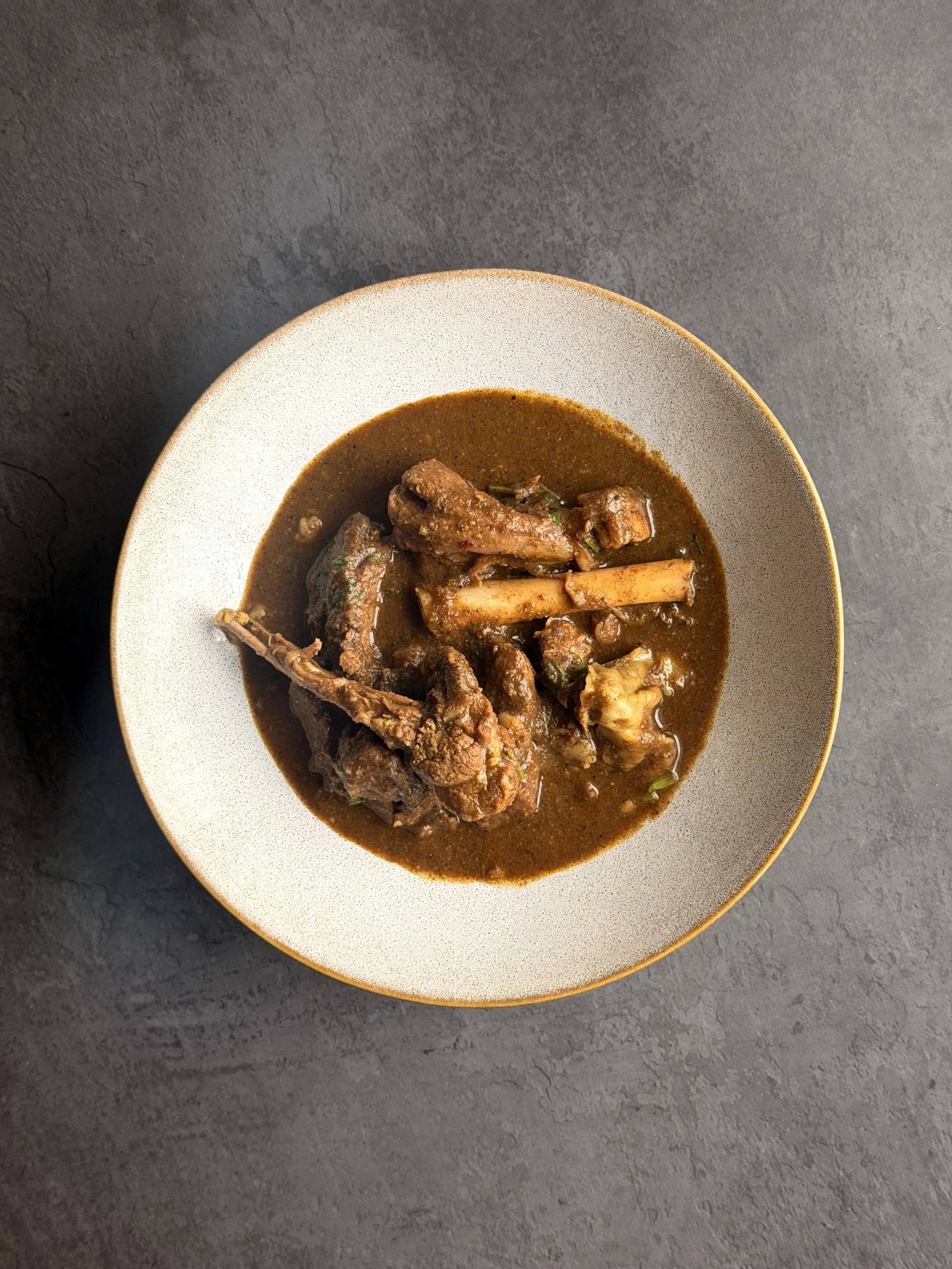
Mutton Saoji
Some dishes are subtle, some are sophisticated, and then there's Saoji mutton, which seems determined to assault every taste bud you possess. Originating from the Saoji community of Nagpur, this famously fiery curry is a glorious exercise in excess. An extraordinary assortment of whole spices, blackened onions, roasted coconut and plenty of chilli come together to create a dark, intensely aromatic gravy that is as complex as it is unapologetically hot.
But what makes a really good Saoji mutton? I've eaten it in Nagpur, and despite following several recipes over the years, I always felt something was missing. Then a friend from Nagpur let me in on what he claimed was a closely guarded secret: dried prawns. I couldn't find a single recipe that mentioned them, but the idea wasn't entirely outrageous. Dried seafood is a fantastic source of umami, and even a small quantity can add remarkable savoury depth without making a dish taste particularly fishy.
So I decided to put his theory to the test. I added some dried prawns to the roasted spice blend, alongside the usual suspects, and cooked the mutton slowly in the resulting masala. The result was remarkably close to the Saoji mutton I remembered from Nagpur.
Whether dried prawns are a genuine family secret, an obscure variation or simply my friend's personal trick remains a mystery. I'm certainly not claiming this is how every Saoji household cooks its mutton. But it worked beautifully, and that's a good enough reason to share the experiment.
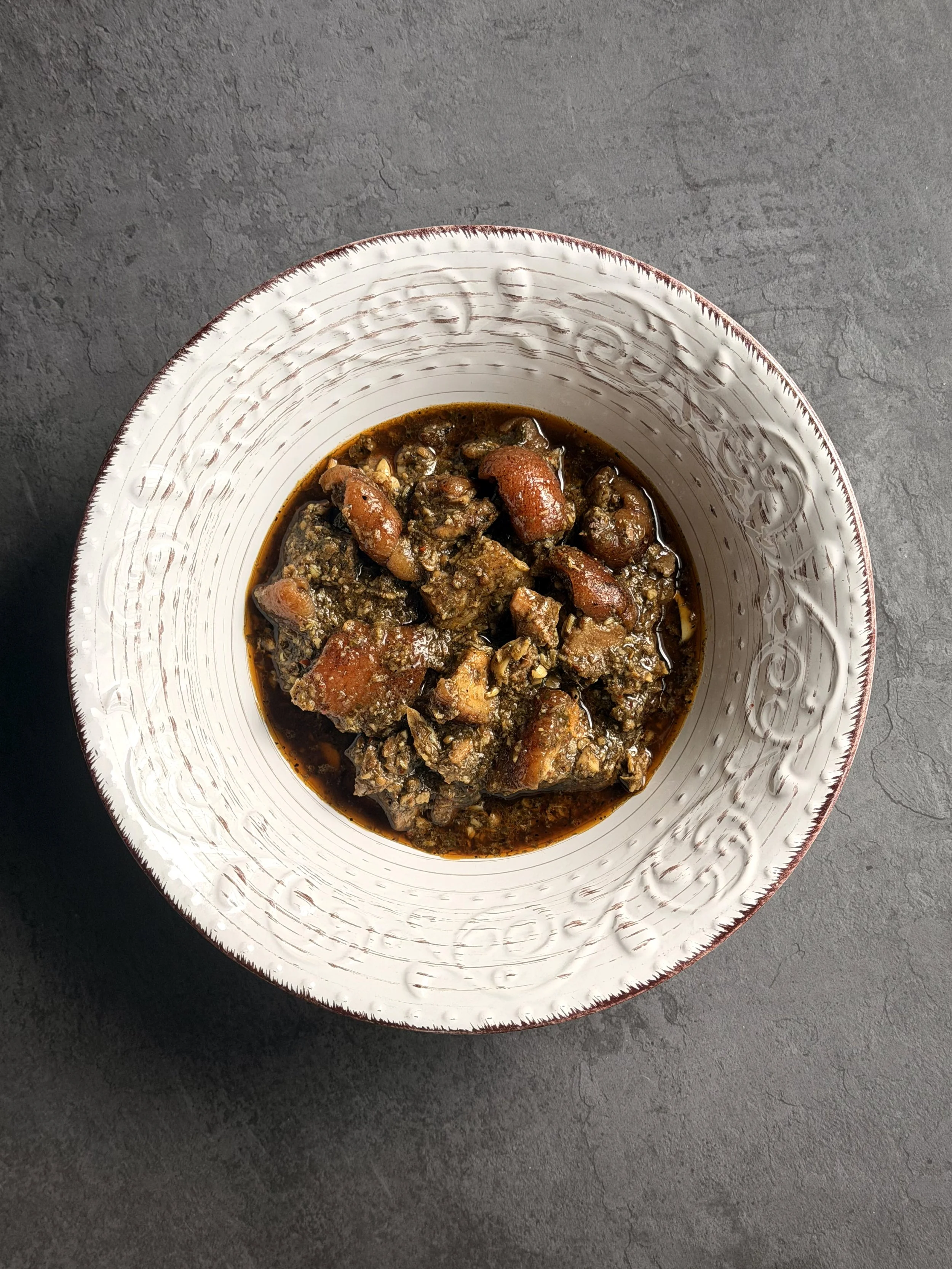
Agri-Style Dukrache Mutton
Some of my fondest childhood memories involve summer vacations at our ancestral village of Gadab, near Pen in Maharashtra. Back then, the forest began right across the road from our house, and a gang of us cousins would spend our days wandering through it, collecting wild fruits and berries. Occasionally, a gunshot would echo through the trees, announcing that someone had hunted a wild boar. We'd wait for smoke to rise above the forest, then head straight towards it. The hunters would be singeing the boar over an open fire to remove its bristles, leaving the skin beautifully crisp and smoky. We'd join the queue of village children, each hoping for a piece of that crackling skin. I still remember its peculiar texture, almost like dried coconut, and the smoky flavour we'd savour on the walk home.
The meat would be cooked with turmeric and an almost unreasonable quantity of garlic, then shared among families, each of whom had their own way of preparing the gravy. This recipe comes from my cousin, who helped me reconstruct our family's version. Surprisingly, it uses very few spices. The real magic lies in the flame-roasted coconut and the coarse vatan, which must be pounded rather than ground smooth. Even the chilli and coriander are deliberately coarse, giving the gravy its distinctive rustic texture.
Wild boar isn't something I can readily get my hands on today, so I've recreated the dish using skin-on pork belly and knuckle, roasting the skin over an open flame to bring back some of that smokiness.
It's not quite the wild boar curry of my childhood, but it's remarkably close to the flavours I remember. And for a recipe that began with a gunshot in the forest, it has turned into a rather lovely exercise in culinary archaeology.
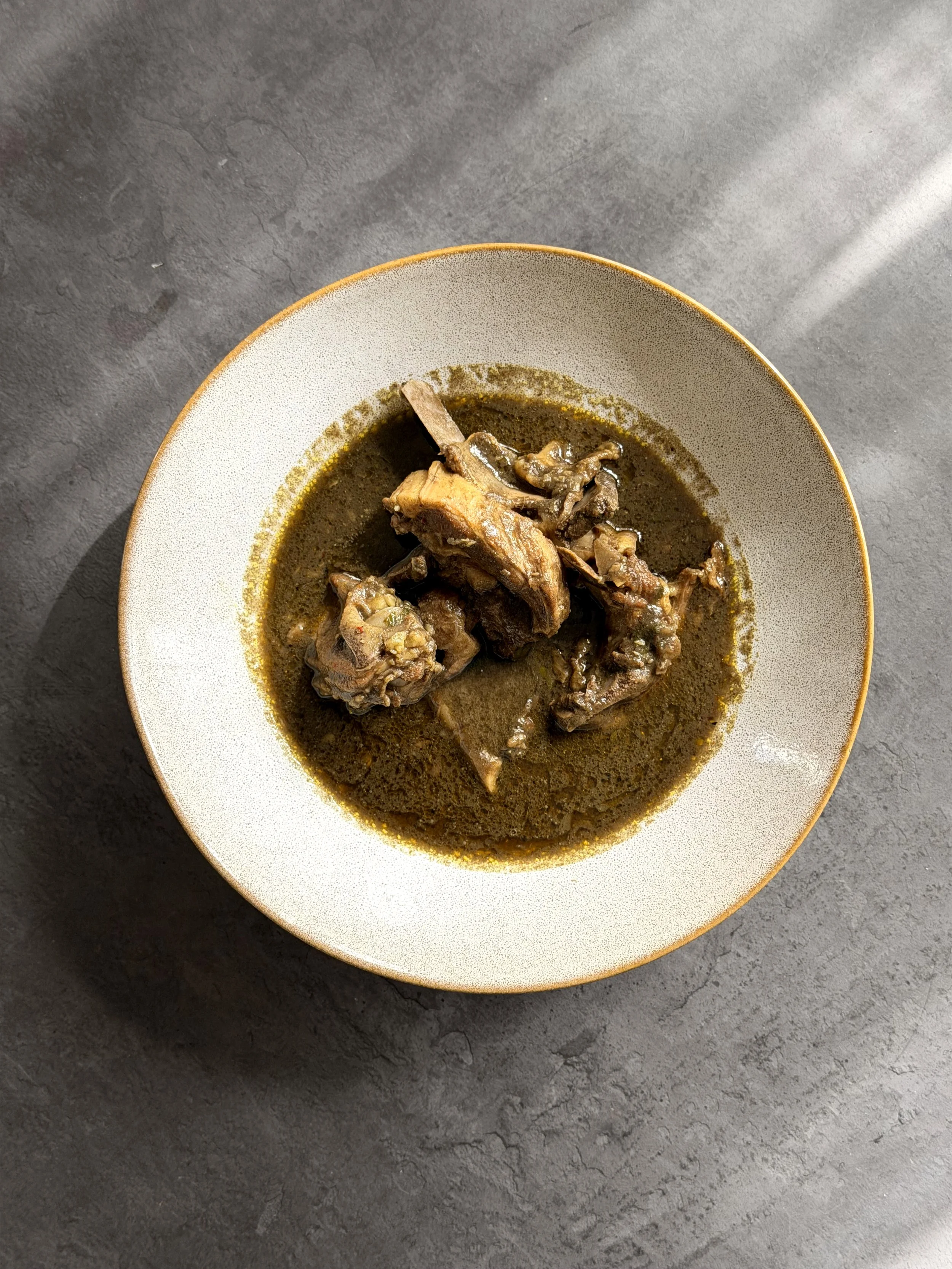
Kanduri Mutton
Kanduri is a traditional communal feast associated with parts of rural Maharashtra, particularly Marathwada, where mutton often takes centre stage. And if there's one thing this style of cooking demonstrates, it's that patience and a little controlled destruction can produce remarkable results.
This version of Kanduri Mutton is all about building flavour in stages. The meat is first cooked separately, producing a rich stock that becomes the foundation of the gravy. Meanwhile, whole onions and dry coconut are roasted directly over a flame until deeply charred, then ground with garlic, ginger and coriander to make a smoky vatan. This paste is slowly fried with kala masala, repeatedly loosened with splashes of mutton stock and reduced again until it develops an almost black-brown colour.
A little yesur, a roasted grain-based mixture, gives the resulting kala rassa just enough body without making it heavy. The tender mutton is returned to the gravy only towards the end.
It's a wonderfully rustic preparation, with no tomatoes, no elaborate garnishes and absolutely no shortcuts. Just fire, fat, spices and the kind of patience that makes a good argument for cooking slowly.
Best served with hot jowar bhakri and a complete disregard for clean fingers.

East Indian Beef Curry
I wanted to see what would happen if an East Indian curry met a piece of beef that had absolutely nowhere to be.
A whole slab of short ribs gets the long treatment with homemade bottle masala, red wine and beef stock, before coconut milk joins the party towards the end. The idea was to let the beef get properly tender without cooking the coconut into oblivion.
Three-and-a-half hours later, the ribs were barely holding onto the bone, the gravy had picked up all that beefy, gelatinous goodness, and the bottle masala was doing exactly what bottle masala does best.
Not exactly a weeknight curry. Very much worth cancelling plans for.

Kulith Amti
Horse gram has a flavour that refuses to disappear politely into a curry. It is earthy, slightly nutty and distinctly itself, so this amti is built around that character rather than trying to cover it up.
The kulith is soaked, sprouted and cooked first, with its cooking liquor saved for the gravy. Kanda lasun masala brings roasted chilli, garlic and coconut depth, while tamarind and jaggery sit quietly in the background doing the Maharashtrian sweet-sour balancing act. A handful of the horse gram gets mashed back into the pot for body, and goda masala and roasted cumin go in towards the end so their aroma survives the journey.
It is dark, hearty and particularly good with rice and a little ghee.
Turns out horse gram has quite a lot to say. Best not interrupt it.

Duck Moile
Duck Moile is a particularly good example of what happened when centuries of Portuguese presence on the Konkan coast collided with the cooking of Mumbai’s East Indian Catholic community. Duck, vinegar, wine and a sweet-sour balance sit alongside ginger, garlic, chillies and that most East Indian of institutions, bottle masala. It remains a festive dish too, particularly associated with Christmas and Easter tables.
Even the name appears to carry a little Portuguese baggage. Moile or moilee is often linked to the Portuguese molho, meaning sauce, although the etymology is repeated more confidently than it is documented, so I’d treat that as a likely linguistic connection rather than courtroom evidence. The Portuguese influence on the dish itself, however, is much easier to see.
My version gets a cup of red wine, coconut vinegar and bottle masala, then reduces until there is barely a gravy left, just a dark, sticky, sharply tart sauce clinging to duck and fried potatoes.
Five hundred years of cultural exchange, and somewhere along the way the duck got wine.

Lonvas
Lonvas begins with a rather excellent proposition: what if the radish got to cook in beef stock?
The East Indian answer involves beef, chunks of radish, coconut milk, tamarind and a generous spoonful of bottle masala. As everything simmers together, the radish goes from sharp and crunchy to soft, juicy little sponges full of beefy, spiced gravy. Frankly, it may be getting the better end of the arrangement.
Bottle masala is responsible for most of the personality here. That famously crowded East Indian spice blend brings heat, warmth and complexity, while tamarind sharpens things up and coconut milk rounds out the gravy at the end.
The beef is excellent, obviously. But don't be surprised if you find yourself fishing around the pot for another piece of radish.

Vaalache Birde
Kadve vaal are the sort of ingredient that make you wonder how hungry the first person who cooked them must have been. Start with a hard, slightly bitter bean, soak it overnight, convince it to sprout, soak it again, peel every single one by hand, then cook it past tender until it begins to fall apart. Somehow, all this trouble leads to something delicious.
This is the Birde my mother makes, although it isn't technically her family recipe. My grandmother was from Sindhudurg, but after moving to Bombay she became particularly fond of her CKP neighbours' cooking and happily adopted several of their recipes. Their sweet and tangy style of Birde was one of them.
The sprouted vaal are cooked with vegetables, coconut, tamarind and jaggery into a thin, sweet-sour gravy.
Apparently family recipes don't always travel down the family tree. Sometimes they just wander over from next door.

Palakachi Patal Bhaji
Palakachi Patal Bhaji is the sort of Maharashtrian spinach preparation that makes the word bhaji feel slightly misleading. Patal means thin, and this is meant to be loose and almost soupy, with spinach cooked alongside peanuts and chana dal in a tangy curd and besan base.
There’s a lot going on for something that looks so unassuming. Jaggery rounds out the sourness of the curd, peanuts and dal give you little interruptions of texture, and then a properly enthusiastic ghee tempering of garlic, chilli, ginger and curry leaves goes over the whole thing at the end.
It’s not the glamorous end of the spinach universe. It is, however, exactly the sort of thing that makes a bowl of hot rice disappear considerably faster than planned.

East Indian Chicken Khuddi
Long before spice blends came with barcodes and ingredient lists, Mumbai’s East Indian families had bottle masala. A fiercely personal blend of spices, traditionally made in large batches, stored in beer bottles and passed down through families, with every household convinced theirs is obviously the best one.
Khuddi is one of the great places to put it to work. A proper East Indian Sunday lunch curry of chicken, potatoes and roasted coconut, deeply spiced with bottle masala and sharpened here with coconut vinegar.
Rich, tangy, comforting and ideally accompanied by fugiya, pao or rice. And if someone offers you their family’s bottle masala recipe, write it down immediately. You may not be asked twice.

Shepu Paratha
Shepu is one of those ingredients that refuses to quietly become “some greens” in the background. Dill is grassy, slightly bitter, intensely aromatic and very much the main character here. Kneaded straight into atta with coriander, green chillies, ginger, sesame and a few everyday spices, it turns a simple paratha into something considerably more interesting. Layer it with ghee, get those edges properly crisp, and serve it hot with curd and pickle. Technically breakfast. Also a perfectly reasonable excuse to eat butter before noon.

Shengdana Chicken
In the kitchens of Vidarbha and Marathwada, peanuts have a habit of sneaking into everyday cooking and making everything considerably more interesting. In Shengdana Chicken, they are roasted, coarsely ground and cooked with Kanda Lasun Masala until they turn into a thick, nutty gravy that clings shamelessly to the chicken. There is no coconut, cream or fancy thickener required. The peanuts have that department covered. Spicy, earthy and unapologetically rustic, this is the sort of curry that makes a bhakri less of an accompaniment and more of an essential piece of eating equipment.

Chawli Usal
Chawli usal is one of those delightfully practical Maharashtrian dishes where a humble bag of beans somehow transforms into a full-on comfort feast. The chawli gets cooked till soft and tender, then it happily simmers away with onions, garlic, Kanda Lasun Masala, and a cheeky little bit of jaggery until the gravy turns thick, spicy, and deeply addictive. The bottle gourd isn’t just along for the ride either, it soaks up all that masala goodness like a sponge and makes the usal extra hearty and satisfying. Scoop it up with bhakri, rice, or pav, or go all out and use it as the base for a very proudly homemade misal.

Phodnicha Bhat
There are few things more satisfying than turning yesterday's rice into today's breakfast. Phodnicha Bhat is the Maharashtrian answer to fried rice. Tossed in a hot tempering of mustard, cumin and curry leaves, with chillies, turmeric and whatever vegetables happen to be hanging around. The magic is in the phodni, or tempering, where a handful of seeds and spices hit hot oil and suddenly make leftovers taste like a plan. Simple, frugal and ridiculously comforting.

Agri-Style Jitada Fish Curry
This is the kind of fish curry where garlic takes up the main character energy. A charred coconut and coriander vatan gives the gravy its earthy backbone, Agri Koli masala brings the heat, and kokum adds just enough sourness to keep everything in check. Then there are those golden, bruised pieces of garlic hiding in the gravy. This is a family recipe from my Agri kitchen, and honestly, finding one of those pieces of garlic in your rice is one of the best parts of the whole operation.