
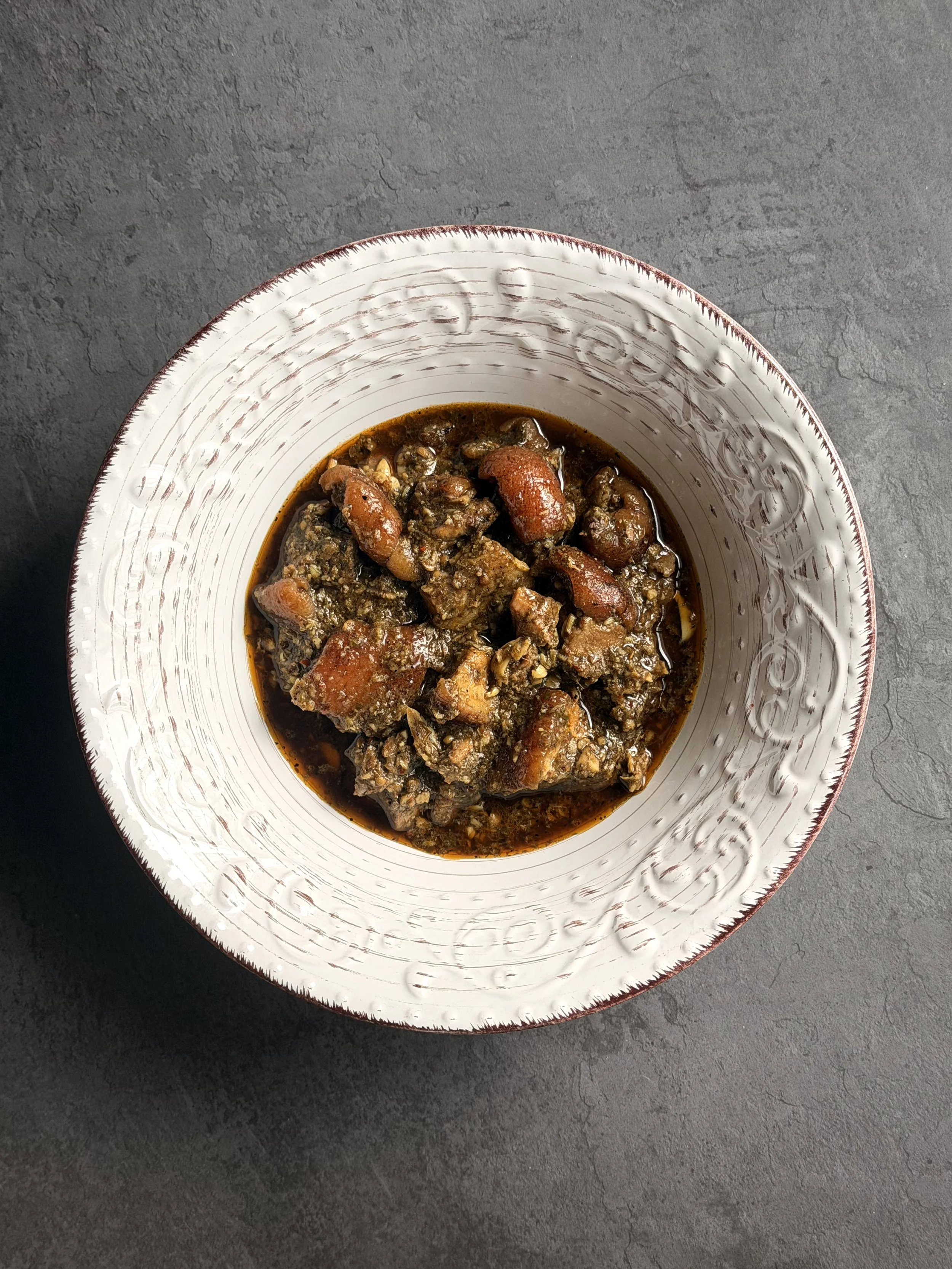
This is my attempt to recreate our family's traditional Agri-style wild boar curry using skin-on pork belly and knuckle. The recipe relies on a few deceptively simple techniques: fire-roasting the skin for smokiness, cooking the meat with an extraordinary amount of garlic, and building a dark, rustic gravy with flame-roasted coconut, fresh coriander and coarsely ground spices. The most important detail is the texture. The vatan must remain coarse, almost as though it has been pounded by hand, rather than ground into a smooth paste. It's a recipe where the technique does most of the heavy lifting, and where a little patience goes a long way.
Ingredients
For the pork and initial cooking
1 kg skin-on pork, preferably in one or two large pieces (pork belly, pork knuckle or a combination)
100 g garlic, peeled and lightly crushed, divided
¾ tsp turmeric powder
Salt, to taste
350 ml water, for the initial cooking
For the coarse vatan
70 g dry coconut (copra)
1 packed cup fresh coriander leaves and tender stems
For the gravy
3 tbsp coarsely ground dried red chilli powder
2 tbsp coarsely ground coriander powder
1 tbsp Agri-Koli masala
2–3 tbsp groundnut oil
Approximately 1 cup reserved pork broth, or as required
Additional water, if required
Salt, to taste
Method
Prepare and fire-roast the pork
Pat the pork pieces thoroughly dry with kitchen paper.
Place a sturdy metal wire rack over a gas burner, positioning the pork approximately 5–6 cm above the flame.
Place the pork on the rack with the skin facing down towards the flame.
Roast the skin over a medium flame, moving and turning the meat frequently with a pair of metal tongs.
The objective is to brown and blister the skin, allowing it to develop patches of dark char without burning it completely.
The skin should gradually become golden-brown to dark brown, with a few blackened patches.
This step recreates, on a smaller scale, the traditional practice of singeing wild boar over an open fire to remove its bristles and develop the characteristic smoky flavour.
Work in batches if necessary, and avoid holding any one section over the flame for too long.
Once the skin is sufficiently roasted, remove the pork from the flame and allow it to cool until comfortable to handle.
Cut the pork into medium-large chunks, approximately 5–6 cm.
Traditionally, wild boar would be cut into relatively small pieces. However, domestic pork, particularly belly, contains considerably more fat and can become very soft during cooking. Keeping the pieces larger helps them retain their structure.
If using pork knuckle, retain the bones at this stage, as they contribute flavour and body to the cooking liquid.
Cook the pork with turmeric and garlic
Place the roasted pork pieces and any bones in a large, heavy-bottomed pot.
Add:
80 g lightly crushed garlic
¾ tsp turmeric powder
Salt, to taste
350 ml water
Mix thoroughly.
Place the pot over medium heat and bring the liquid to a boil.
Reduce the heat to low, cover with a lid and allow the pork to simmer gently until tender.
Stir occasionally, turning the pieces so they cook evenly.
The pork will gradually release its own fat and juices, creating a rich, garlicky broth.
Cook until the meat is tender enough to pierce easily with a fork but has not completely fallen apart.
Depending on the cuts used, this may take approximately 60–120 minutes. Pork belly may become tender sooner than knuckle, so check the pieces individually and remove any that are ready.
Add a little hot water if the cooking liquid reduces too quickly.
The aim is to cook the meat gently while retaining enough flavourful broth to prepare the gravy.
Prepare the flame-roasted coconut vatan
While the pork cooks, prepare the vatan.
Take the 70 g piece of dry coconut and roast it directly over a gas flame, holding it securely with metal tongs.
Turn it frequently until the exterior develops dark brown and blackened patches.
The coconut should be deeply roasted and smoky, with some charred areas, but not reduced to ash.
Remove it from the flame and allow it to cool.
Cut or break the roasted coconut into smaller pieces.
Transfer the coconut and fresh coriander leaves to a mortar and pestle or a mixer-grinder.
Pound or pulse briefly to produce a very coarse mixture.
Do not add water.
The finished vatan should contain visible fragments of roasted coconut and roughly crushed coriander leaves.
It should resemble a coarse, irregularly pounded mixture rather than a smooth paste.
A few larger pieces of coconut are not only acceptable but desirable.
This texture is one of the most important characteristics of the dish. A finely ground coconut paste would produce a much smoother gravy and change the rustic character of the preparation.
Separate the cooked pork and broth
Once the pork is tender, remove the pot from the heat.
Carefully lift out the pork pieces and transfer them to a separate bowl.
Strain or ladle the cooking liquid into another container, reserving all of it.
Do not discard the broth, as it contains the flavour of the pork, garlic, turmeric and rendered fat.
If the knuckle contains particularly large bones, remove the meat from them at this stage and discard the bones.
Keep the pork pieces as intact as possible.
Set the cooked meat and reserved broth aside while preparing the gravy.
Fry the garlic and spices
Heat 2–3 tbsp groundnut oil in a heavy-bottomed kadai over medium heat.
Add the remaining 20 g lightly crushed garlic.
Fry gently until the garlic becomes fragrant and lightly golden.
Reduce the heat to low.
Add the Agri-Koli masala, coarsely ground red chilli powder and coarsely ground coriander powder.
Immediately add a small splash of the reserved pork broth to prevent the spices from scorching.
Stir and fry the mixture until the spices become fragrant and the liquid has mostly evaporated.
The coarse chilli and coriander powders should remain visibly textured rather than dissolving into a smooth masala.
Fry the coarse coconut vatan
Add the prepared coconut and coriander vatan to the kadai.
Mix thoroughly with the fried garlic and spices.
Continue frying over medium-low heat, stirring frequently.
As the mixture begins to dry out and stick lightly to the bottom of the kadai, add another small splash of the reserved pork broth.
Stir well, scraping up the browned masala from the bottom.
Allow the liquid to evaporate and continue frying.
Repeat this process several times, adding small quantities of broth whenever the masala becomes too dry.
This repeated frying and deglazing helps develop the deep, dark colour and concentrated flavour characteristic of the dish.
The coconut will continue to toast, the spices will darken and the mixture will gradually become a coarse, deeply browned masala.
Take your time with this stage.
The masala should become dark brown and aromatic, with visible pieces of roasted coconut and coriander.
Avoid burning the spices, particularly the chilli powder, which can become bitter if exposed to excessive heat.
Add the cooked pork
Once the masala is thoroughly fried, add the reserved cooked pork pieces.
Stir gently to coat the meat with the dark coconut mixture.
Fry for approximately 3–5 minutes, allowing the masala to cling to the surface of the pork.
Be careful not to break up the softer pieces of pork belly.
Adjust the gravy
Add the remaining reserved pork broth, using approximately 1 cup of liquid in total, or adjusting according to the consistency you prefer.
If there is insufficient broth, make up the difference with hot water.
Stir gently to combine.
Bring the mixture to a boil, then reduce the heat and simmer uncovered.
Cook until the gravy reaches the desired consistency and the oil begins to separate around the edges.
Rest and serve
Taste the gravy and adjust the salt if required.
Remove the kadai from the heat and allow the dish to rest for approximately 15 minutes.
This gives the pork time to absorb some of the flavours of the masala and allows the gravy to settle.
Serve hot with rice or freshly made bhakri.
Notes
Wild boar versus domestic pork: The original preparation uses wild boar, which is generally leaner and has a more pronounced flavour than farmed pork. Skin-on pork belly and knuckle provide a practical alternative, although the finished dish will be richer and fattier.
Why the skin is roasted: Traditionally, wild boar is singed over an open fire to remove its bristles. This also scorches the skin and contributes a distinctive smoky flavour. Roasting the skin of domestic pork before cutting and cooking it helps approximate this characteristic.
The importance of garlic: Garlic is a defining ingredient in this preparation. The quantity may seem excessive, but the initial cooking mellows its sharpness, while the garlic fried separately in the gravy adds another layer of flavour. The balance varies from household to household.
The coarse vatan: Unlike many Maharashtrian gravies, where coconut and aromatics are ground into a relatively smooth paste, this preparation relies on a deliberately coarse vatan. The uneven texture, with visible pieces of coconut, is essential to the character of the dish.
Roasting the coconut: The dry coconut should be roasted until deeply browned, with patches of char. This provides both colour and smokiness. Avoid burning it completely, as excessive charring can make the gravy unpleasantly bitter.
Coarsely ground spices: Use coarsely ground dried red chilli and coriander rather than fine commercial powders, if possible. Their granular texture contributes to the rustic consistency of the gravy.
Agri-Koli masala: This spice blend provides an additional layer of warmth and complexity. The exact composition varies between households, so the final flavour will depend partly on the masala used.
Gravy consistency: The amount of liquid can be adjusted depending on how the dish will be served. A drier preparation works particularly well with bhakri, while a slightly looser gravy can be enjoyed with rice.
A family preparation: This recipe represents one household's version of Agri-style dukrache mutton from the Pen region. As with many traditional dishes, ingredients, proportions and techniques can vary considerably between villages and families.