
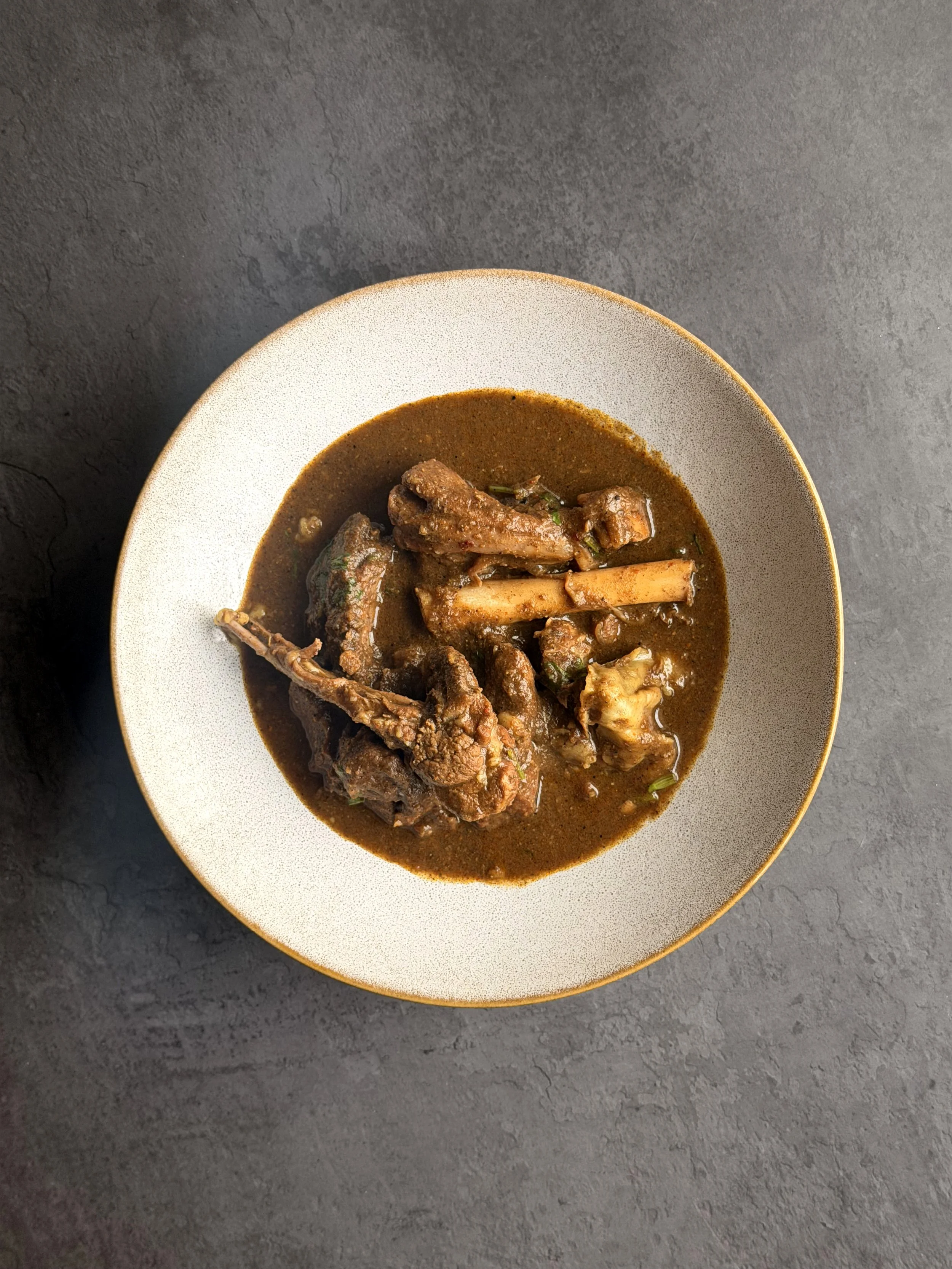
Saoji cuisine is closely associated with Nagpur and the surrounding Vidarbha region of Maharashtra. Known for its intensely spiced, dark gravies, Saoji cooking makes generous use of whole spices, dried chillies, roasted coconut and deeply browned onions. The resulting curries are rich, aromatic and unapologetically fiery.
This version of Mutton Saoji uses a particularly elaborate spice paste, or vatan, made with roasted whole spices, Byadgi chillies, stone flower, sesame seeds, poppy seeds, dry coconut and flame-roasted onions. A separate ginger-garlic-coriander paste forms the aromatic base, while hot red chilli powder provides additional heat.
The secret lies in patiently frying the vatan until it darkens, becomes almost crumbly and releases its oil. The mutton is then cooked slowly in this concentrated masala until tender, producing a deeply flavoured, semi-thick gravy.
Ingredients
For the roasted spice vatan
Cinnamon: 3-inch piece
Green cardamom: 6 pods
Black cardamom: 4 pods
Black peppercorns: 10
Star anise: 1 whole
Cloves: 12
Cumin seeds: 2 tbsp
Shah jeera (caraway seeds): 2 tsp
Coriander seeds: ¼ cup
Nutmeg: ¼ whole
Mace: 1 blade
Dried Byadgi chillies: 8
Raw rice: 1 tbsp
Roasted chana dal (dalia): 2 tbsp
Bay leaves: 3
Dried prawns: 1.5 tbsp (optional)
Stone flower (dagad phool): 1 small handful
Poppy seeds (khus khus): 1 tbsp
White sesame seeds: 2 tbsp
Spinach: 2-3 leaves
Onions: 4 medium
Dry coconut (copra): ¼ whole coconut
Water: As required for grinding
For the ginger-garlic-coriander paste
Garlic: 25–30 cloves
Ginger: 4–5-inch piece
Fresh coriander leaves and tender stems: 1 small handful
Water: As required for grinding
For the mutton curry
Bone-in mutton: 1.5 kg
Groundnut oil: ½ cup (120 ml)
Turmeric powder: ½ tsp
Hot red chilli powder: 3 tbsp
Prepared roasted spice vatan: All
Prepared ginger-garlic-coriander paste: All
Hot water: As required
Salt: To taste
Kala masala: 1 tbsp (optional)
Fresh coriander leaves, chopped: 1 handful
Method
Dry-roast the whole spices
Place a heavy-bottomed frying pan over medium-low heat. Add the cinnamon, green cardamom, black cardamom, black peppercorns, star anise, cloves, cumin seeds, shah jeera, coriander seeds, nutmeg and mace.
Dry-roast gently for 2–3 minutes, stirring continuously, until the spices become aromatic.
Add the dried Byadgi chillies, raw rice, roasted chana dal, bay leaves and dried prawns, if using. Continue roasting over medium-low heat until the chillies become crisp, the rice begins to toast and the dried prawns become fragrant.
Keep stirring to prevent the smaller spices from burning.
Add the stone flower, poppy seeds and sesame
Add the stone flower, poppy seeds and white sesame seeds to the roasted spice mixture.
Continue roasting for another 1–2 minutes, stirring continuously, until the sesame seeds become lightly golden and aromatic.
Transfer everything to a bowl and allow it to cool completely.
Flame-roast the onions and dry coconut
Peel the onions and leave them whole.
Place them directly over a gas flame using a sturdy wire rack or suitable metal tongs. Roast, turning frequently, until the outer layers become blistered and develop dark brown and blackened patches.
The onions should soften slightly and develop a pronounced smoky aroma.
Remove them from the flame and allow them to cool.
Next, roast the dry coconut directly over the flame, turning frequently until its surface becomes deeply browned with some charred patches. Avoid burning it completely, as excessively blackened coconut can introduce bitterness.
Allow the coconut to cool, then chop it into small pieces.
Grind the roasted vatan
Transfer the cooled roasted spices to a mixer-grinder.
Add the flame-roasted onions, chopped dry coconut and spinach leaves.
Add a small quantity of water and grind everything into a fine, thick paste. Add only enough water to help the blades move.
Unlike some rustic Maharashtrian vatans, which are deliberately kept coarse, this Saoji masala is ground relatively smooth.
The finished paste should be thick and concentrated rather than watery. Set aside.
Prepare the ginger-garlic-coriander paste
Add the garlic cloves, ginger and fresh coriander to a mixer-grinder.
Pour in a little water and grind to a smooth, slightly loose paste.
This mixture should be more fluid than the roasted spice vatan so that it fries evenly when added to the hot oil.
Set aside.
Fry the ginger-garlic paste
Heat ½ cup groundnut oil in a large, heavy-bottomed handi or deep kadai over medium-high heat.
Once the oil is hot, add the prepared ginger-garlic-coriander paste.
Fry for approximately 2–3 minutes, stirring continuously, until the raw aroma of ginger and garlic begins to disappear.
The paste will initially splutter because of its water content. Continue frying until it becomes fragrant and some of its moisture evaporates.
Add the powdered spices and roasted vatan
Reduce the heat to low.
Add the turmeric powder and hot red chilli powder. Stir briefly, taking care not to burn the chilli powder.
Immediately add the prepared roasted spice vatan and mix thoroughly.
Increase the heat slightly to medium-low and begin frying the masala.
This is one of the most important stages of the recipe.
Initially, the vatan will appear thick and moist. As it cooks, the water will gradually evaporate and the masala will begin to darken.
Continue frying for approximately 12–15 minutes, stirring frequently and scraping the bottom of the handi to prevent sticking.
The masala should become noticeably darker, thicker and almost crumbly, with oil beginning to separate around the edges.
The finished masala should have a deep reddish-brown colour and a powerful roasted-spice aroma.
Do not rush this stage. Thorough frying of the vatan is essential for developing the characteristic depth of Saoji gravy.
If the masala begins to stick before it is properly fried, reduce the heat and add a small splash of water.
Add and fry the mutton
Increase the heat to medium-high.
Add the cleaned and drained mutton pieces to the fried masala.
Stir thoroughly, making sure every piece is coated with the thick spice mixture.
Continue frying for approximately 5–6 minutes, turning the meat frequently.
The mutton will gradually release some moisture into the masala. Continue frying until the meat is well coated and the spices begin adhering to its surface.
Cook the mutton in its own juices
Traditionally, this method uses a large metal parat placed over the handi as a lid.
Place a deep, heat-safe metal parat over the handi and pour water into it.
The water helps keep the lid relatively cool, encouraging steam to condense on its underside. It also gradually heats up for use later in the curry.
Reduce the heat to low and allow the mutton to cook in its own juices for approximately 10–12 minutes.
During this time, the meat will release moisture, which will mix with the concentrated masala.
Avoid opening the handi unnecessarily.
Alternative: If you do not have a suitable parat, use a tight-fitting lid and heat the required water separately.
Add hot water and simmer
After approximately 10–12 minutes, carefully remove the parat.
The mutton should have released some liquid, and the masala should have loosened slightly.
Add the hot water from the parat to the handi, a little at a time, stirring thoroughly.
Start with approximately 500 ml hot water, adding more later if required. The consistency should be semi-thick.
Bring the gravy to a gentle boil, then reduce the heat to low and cover the handi.
Allow the mutton to simmer gently until tender.
Depending on the age and cut of the goat, this may take approximately 60–120 minutes or longer.
Stir occasionally, checking that the masala is not sticking to the bottom. Avoid lifting the lid too frequently.
If the gravy reduces too quickly, add a little more hot water.
The mutton should eventually become tender, while the gravy develops a deep, dark colour and a rich, concentrated flavour.
Finish with kala masala
Once the mutton is fully tender, remove the lid.
If using kala masala, add 1 tbsp and stir thoroughly.
Allow the curry to simmer uncovered for another 5–10 minutes so that the kala masala blends into the gravy and any excess liquid evaporates.
Continue cooking until the gravy reaches your preferred consistency.
The finished Saoji curry should have a rich, semi-thick gravy with some oil visible around the edges.
Taste and adjust the salt.
Garnish and serve
Switch off the heat and add a generous handful of freshly chopped coriander leaves.
Stir gently and allow the curry to rest, covered, for approximately 10–15 minutes before serving.
Serve hot with jowar bhakri, chapati or steamed rice.