
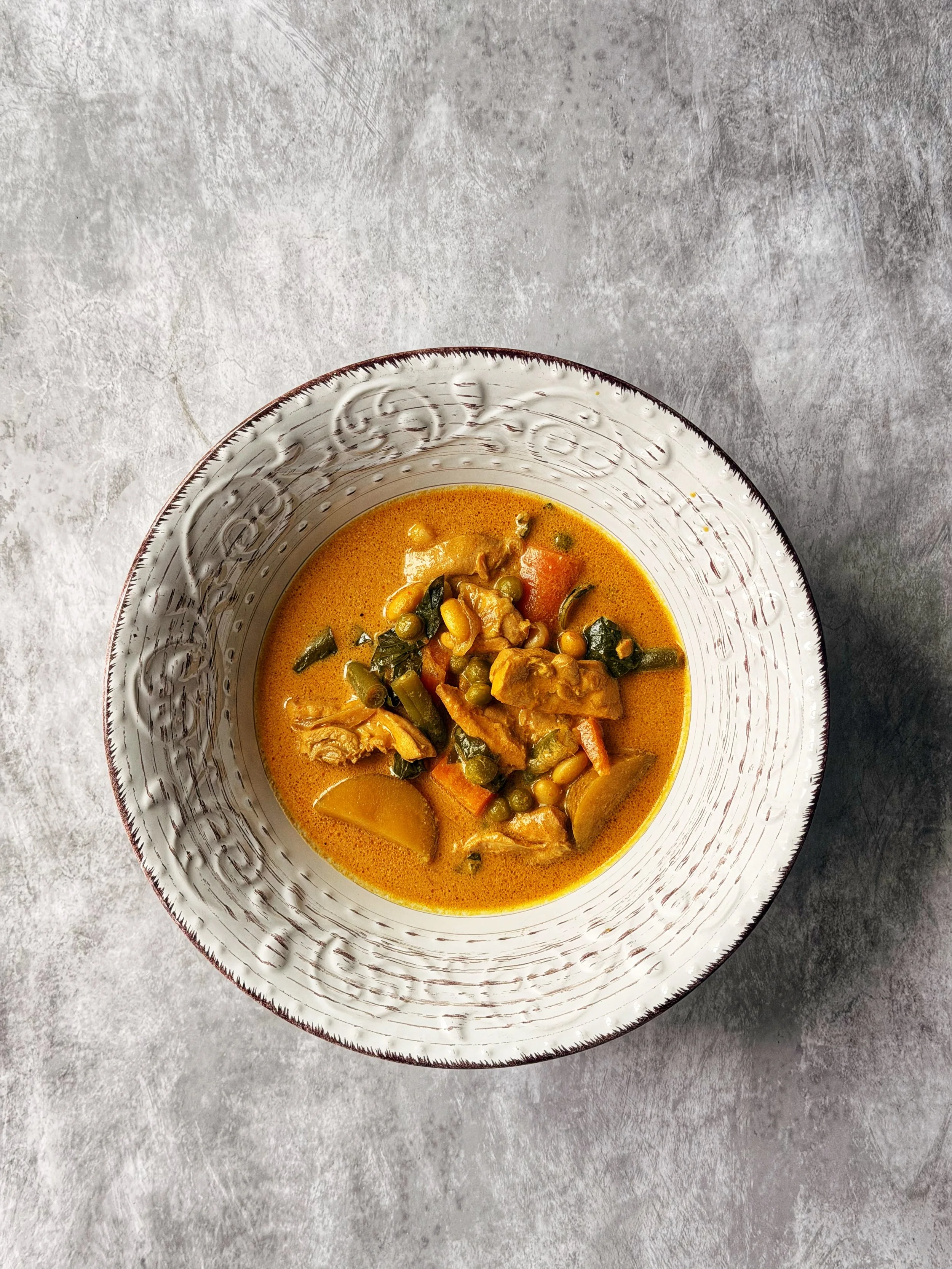
Thai yellow curry, or Gaeng Kari, is a rich, aromatic coconut milk curry that reflects the influence of Indian spices on Thai cooking. Unlike the sharper, herbaceous flavours of Thai green curry or the intense chilli heat of red curry, yellow curry is generally milder, warmer and more rounded, with turmeric providing its characteristic golden colour.
The curry paste combines traditional Thai aromatics such as lemongrass, galangal, shallots, garlic and fermented shrimp paste with ground coriander, cumin, cardamom and fenugreek. The result is a fragrant, gently spiced curry balanced with coconut milk, fish sauce, palm sugar and tamarind.
This version uses chicken thighs and a mixture of vegetables, but the same curry paste can be used with seafood, beef or other proteins.
Ingredients
For the Thai Yellow Curry Paste
Mild dried red chillies: 10
Fresh bird's eye chillies: 2–4, deseeded and roughly chopped
Lemongrass: 2 stalks
Shallots: ½ cup (approximately 70–80 g), chopped
Fresh turmeric: 2 tbsp, thinly sliced
Galangal: 2 tbsp, thinly sliced
Garlic: 8 cloves
Fermented shrimp paste (kapi): 1½ tbsp
Ground coriander: 1 tsp
Ground cumin: 1 tsp
Ground cardamom: ¼ tsp
Ground fenugreek: ½ tsp
Ground white pepper: ⅛ tsp
Reserved chilli soaking water: Approximately 3 tbsp, or as required
For the Curry
Boneless chicken thighs: 500 g, cut into bite-sized pieces
Mixed vegetables: 1½ cups (approximately 200–250 g), cut into bite-sized pieces
Neutral cooking oil: 3 tbsp
Chicken stock, preferably low-sodium: 1 cup (240 ml)
Coconut milk: 400 ml
Fish sauce: 4 tsp, plus more to taste
Palm sugar: 5 tsp (approximately 20–25 g), finely chopped
Tamarind purée: 2 tsp
Prepared Thai yellow curry paste: All
Suggested vegetables: Potatoes, carrots, green beans, peas and bamboo shoots. Choose a mixture that provides contrasting textures, keeping in mind that different vegetables require different cooking times.
For Garnishing and Serving
Thai basil leaves: 1 small handful
Fresh red chilli: 1, thinly sliced (optional)
Crispy fried shallots: 2 tbsp
Method
Soak the dried chillies
Remove the stems from the dried red chillies.
Roughly chop them, shaking out most of the seeds if you prefer a milder curry.
Place the chillies in a heatproof bowl and pour over enough boiling water to cover them completely.
Allow them to soak for approximately 30 minutes, or until they become soft and pliable.
Drain the chillies, reserving a small quantity of the soaking liquid for grinding the curry paste.
The soaking process softens the dried chillies and helps them blend into a smoother paste.
Prepare the lemongrass
Trim away the dry, woody upper portions of the lemongrass stalks and remove the tough outer layers.
Use only the tender, pale lower sections.
Bruise the stalks lightly with the back of a knife, then slice them as thinly as possible.
Finely slicing the lemongrass is important because its fibres can be difficult to break down completely in a domestic mixer-grinder.
Prepare the curry paste
Place the soaked dried chillies, fresh bird's eye chillies, sliced lemongrass, chopped shallots, fresh turmeric, galangal and garlic in a mixer-grinder or high-powered blender.
Add the fermented shrimp paste, ground coriander, cumin, cardamom, fenugreek and white pepper.
Pour in approximately 3 tbsp of the reserved chilli soaking water.
Grind everything into a thick, smooth paste.
Stop occasionally to scrape down the sides of the jar and continue grinding until the ingredients are thoroughly incorporated.
The finished paste should be relatively smooth, without noticeable hard fibres from the lemongrass or galangal.
To check, rub a small amount of paste between your fingers. If it feels excessively gritty or fibrous, continue grinding.
Add a little more soaking water only if necessary to help the blades move.
Set the prepared paste aside.
Prepare the chicken and vegetables
Cut the boneless chicken thighs into approximately 3–4 cm pieces.
Prepare the vegetables according to their cooking times.
Cut potatoes and carrots into relatively small, even pieces so they cook at a similar rate.
Trim the green beans and cut them into approximately 3–4 cm lengths.
If using bamboo shoots, drain and rinse them before adding them to the curry.
Keep the vegetables separated according to how long they will take to cook.
Fry the curry paste
Heat 3 tbsp neutral cooking oil in a heavy-bottomed wok, kadai or deep saucepan over medium heat.
Add the prepared yellow curry paste.
Fry for approximately 3–4 minutes, stirring continuously.
Initially, the paste will appear moist and slightly loose. As it cooks, some of the water will evaporate and the paste will become thicker and more concentrated.
Continue frying until it becomes intensely aromatic and the raw smell of the shallots, garlic and turmeric begins to disappear.
The oil may begin to separate slightly around the edges.
Avoid frying over excessively high heat, as the chilli and ground spices can burn and become bitter.
Add the stock
Pour in 1 cup chicken stock.
Stir thoroughly, scraping the bottom of the pan to release any curry paste that may have adhered during frying.
Bring the mixture to a gentle simmer.
Allow it to cook for approximately 2–3 minutes so that the curry paste disperses evenly into the stock.
The liquid should become fragrant and develop a rich yellow-orange colour.
Season the curry
Reduce the heat to medium-low.
Add the tamarind purée, fish sauce and finely chopped palm sugar.
Stir until the palm sugar has dissolved completely and the tamarind is evenly incorporated.
Pour in approximately 300 ml coconut milk, reserving the remaining 100 ml for finishing the curry.
Stir gently until the coconut milk is thoroughly combined with the spiced stock.
Bring the sauce back to a gentle simmer.
Avoid boiling it vigorously, as prolonged high heat can cause the coconut milk to separate excessively.
Add the chicken and vegetables
Begin adding the chicken and vegetables according to their cooking times.
If using potatoes and carrots, add them first and allow them to simmer for approximately 5 minutes.
Add the chicken thigh pieces and stir gently to coat them in the curry sauce.
Continue simmering for approximately 5–7 minutes.
Next, add the green beans and bamboo shoots.
Stir gently and continue cooking until the vegetables are tender and the chicken is fully cooked.
The potatoes and carrots should be tender but still hold their shape, while the green beans should retain a little bite.
The total cooking time will depend on the size of the pieces and the vegetables used.
Simmer gently
Reduce the heat to low and cover the pan.
Allow the curry to simmer gently until the chicken and vegetables are cooked to your liking.
Stir occasionally to ensure the coconut milk does not catch at the bottom.
If the curry becomes too thick during cooking, add a small splash of stock or hot water.
The finished sauce should be rich and creamy, with enough liquid to coat the chicken and vegetables generously.
Adjust the seasoning
Once the chicken and vegetables are cooked, taste the curry sauce.
Thai yellow curry should have a rounded balance of savoury, sweet, mildly sour and aromatic flavours.
Adjust as required:
For more saltiness and savoury depth, add a little more fish sauce.
For additional sweetness, add a small amount of palm sugar.
For more acidity, add a little additional tamarind purée.
If the sauce is too concentrated, thin it with a small quantity of stock or hot water.
Make adjustments gradually, tasting after each addition.
The aim is a balanced curry in which no single seasoning overwhelms the coconut milk and aromatic paste.
Finish with coconut milk
Pour in the reserved 100 ml coconut milk.
Stir gently to incorporate it into the curry.
Bring the sauce just back to a gentle simmer, then switch off the heat.
Adding some coconut milk towards the end helps preserve its fresh coconut aroma and gives the finished curry a rich, creamy consistency.
Allow the curry to rest for approximately 5 minutes before serving.
Garnish and serve
Scatter fresh Thai basil leaves over the top.
Garnish with thinly sliced red chilli and crispy fried shallots.
Serve hot with steamed jasmine rice.