
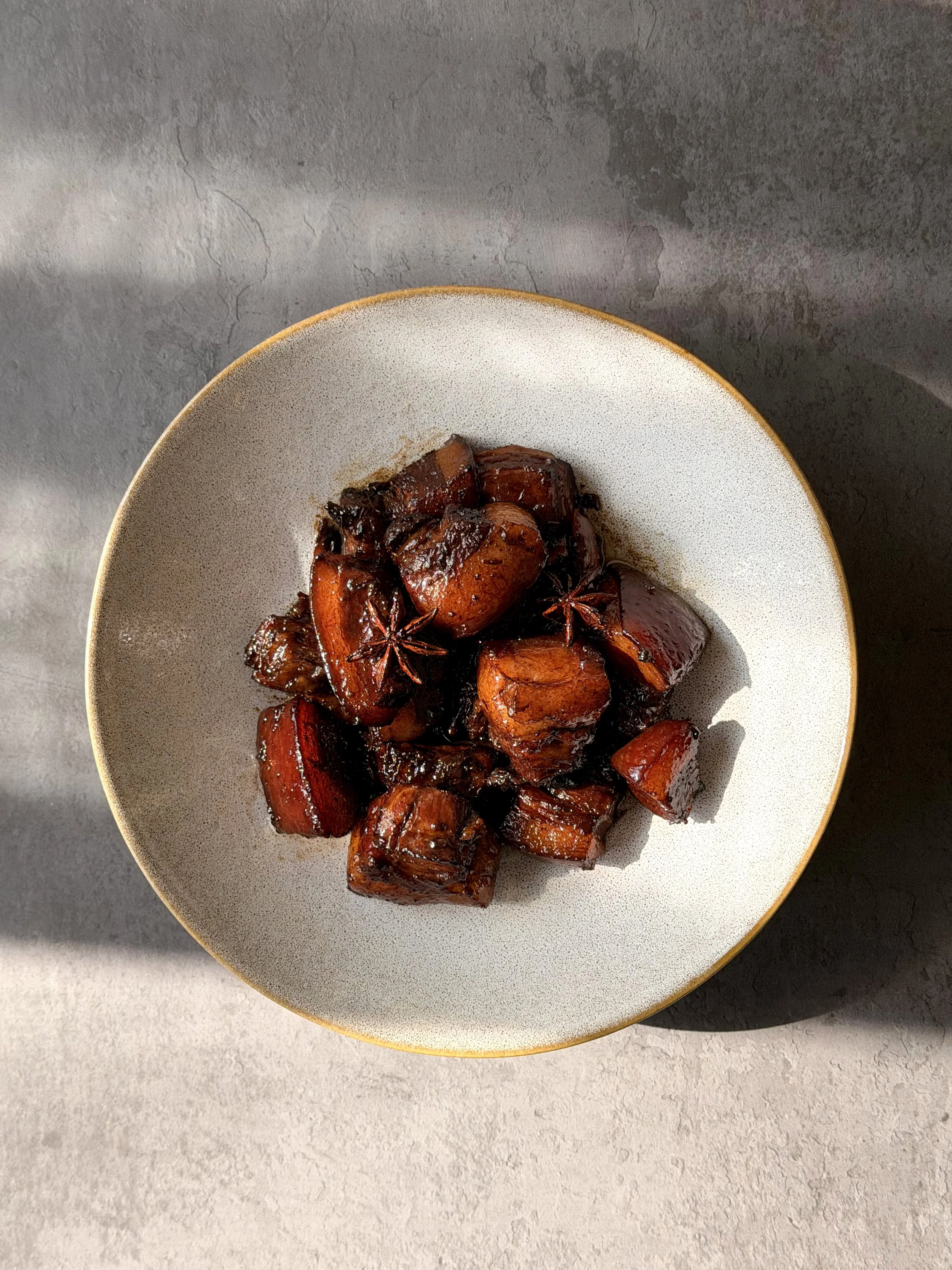
Hong Shao Rou, or red-braised pork belly, is a classic Chinese preparation in which pork is slowly simmered with soy sauce, Shaoxing wine, sugar and aromatics until the meat becomes tender and the cooking liquid reduces to a rich, glossy glaze. The Shanghai-style version is particularly known for its slightly sweet flavour, deep reddish-brown colour and melt-in-the-mouth texture.
The technique is relatively simple. The pork belly is first blanched to remove impurities, then lightly caramelised with sugar before being braised in a mixture of soy sauces, wine and aromatics. As the liquid reduces, the rendered pork fat, sugar and soy sauce come together to form a beautifully glossy coating around each piece of meat.
Ingredients
Skin-on pork belly, preferably with alternating layers of meat and fat: 700 g
Neutral cooking oil: 2 tbsp
Rock sugar: 25 g (approximately 2 tbsp), or granulated sugar
Shaoxing wine: 80 ml (⅓ cup)
Light soy sauce: 2 tbsp
Dark soy sauce: 1 tbsp
Fresh ginger: 4–5 slices
Star anise: 2 whole
Bay leaves: 2
Water: 500–750 ml, or as required
Method
Blanch the pork belly
Place the whole piece of pork belly in a saucepan and add enough cold water to cover it completely.
Bring the water to a boil over medium-high heat. Once boiling, cook for approximately 1 minute, or until the surface of the pork turns opaque and some impurities rise to the surface.
Remove the pork belly from the saucepan and rinse it under clean water to remove any scum.
Discard the blanching water.
Allow the pork to cool slightly, then cut it into approximately 2 cm (¾-inch) cubes, keeping the skin attached to each piece.
Caramelise the sugar
Heat a wok or heavy-bottomed pot over low heat.
Add the neutral cooking oil and rock sugar.
Allow the sugar to melt slowly, stirring gently as required. If using rock sugar, it may take a little longer to dissolve.
Continue heating until the sugar develops a light amber colour.
Take care not to let the caramel become too dark, as burnt sugar will introduce bitterness into the finished dish.
Brown the pork belly
Add the blanched pork belly pieces to the caramelised sugar.
Increase the heat to medium and stir-fry for approximately 4–5 minutes, turning the pieces frequently.
The pork should become lightly browned and evenly coated with the caramel.
As the pork heats up, some of its fat will begin to render into the wok.
Continue frying until the pieces develop a light golden-brown colour.
Add the Shaoxing wine and soy sauces
Reduce the heat to low.
Pour in the Shaoxing wine, taking care as it may bubble vigorously when it comes into contact with the hot wok.
Stir thoroughly to loosen any caramelised bits from the bottom.
Allow the wine to simmer for approximately 2 minutes.
Add the light soy sauce and dark soy sauce.
Stir-fry for another minute, making sure the pork is evenly coated.
The dark soy sauce will begin giving the pork its characteristic deep reddish-brown colour.
Add the aromatics and water
Add the ginger slices, star anise and bay leaves.
Pour in approximately 500 ml water, or enough to nearly cover the pork.
Stir gently to combine everything.
Bring the liquid to a gentle boil, then reduce the heat to maintain a steady, low simmer.
Slowly braise the pork belly
Cover the wok or pot with a lid and allow the pork to simmer gently for approximately 60–90 minutes, or until the meat becomes tender.
The exact cooking time will depend on the thickness of the pork belly and the size of the pieces.
Check the pork every 15–20 minutes, stirring gently to prevent the sauce from sticking to the bottom.
If the liquid reduces too quickly before the pork becomes tender, add a small quantity of hot water.
Avoid allowing the sauce to dry out during this stage.
The pork is ready for the final reduction when a fork or chopstick passes easily through the meat and the fatty layers have become soft and gelatinous.
Reduce the braising liquid
Once the pork is tender, remove the lid.
If there is still a considerable amount of liquid remaining, increase the heat to medium-high.
Allow the sauce to boil and reduce, stirring frequently.
As the water evaporates, the sauce will become progressively thicker, darker and glossier.
Continue reducing until the liquid forms a rich, syrupy glaze that clings to the pork.
During the final few minutes, stir almost continuously to prevent the sugar and soy sauce from burning.
The finished pork should have a deep reddish-brown colour, with each piece coated in a shiny, caramelised sauce.
There should be very little free liquid remaining in the wok.
Rest and serve
Turn off the heat and allow the pork to rest for approximately 5 minutes.
Remove the star anise and bay leaves if desired.
Transfer the pork to a serving bowl and spoon any remaining glaze over the top.
Serve hot with steamed jasmine rice and a simple green vegetable such as blanched bok choy or stir-fried Chinese greens.