
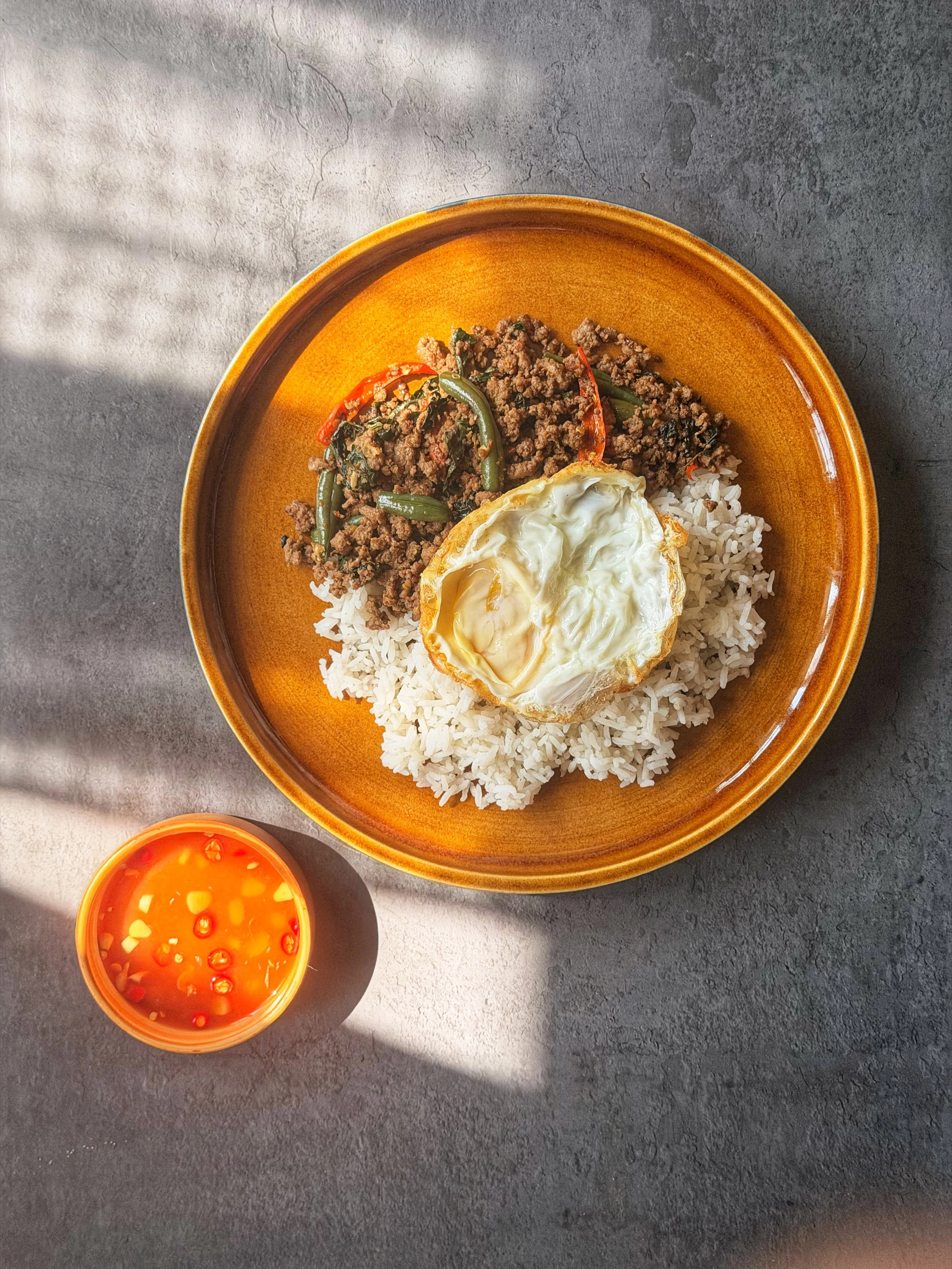
Pad Kra Pao is one of Thailand's most popular everyday dishes, a fiery, intensely aromatic stir-fry traditionally made with holy basil, garlic, chillies and a savoury sauce. It's a staple of Thai street-food stalls and small restaurants, usually served over steamed jasmine rice with a crispy-edged fried egg known as kai dao.
This version uses minced beef with a little fat for richness, two varieties of Thai chillies for different layers of heat, and long beans for added texture. The beef is first browned thoroughly in a hot wok before the garlic-chilli paste and seasonings are added. The holy basil goes in right at the end, allowing its distinctive peppery aroma to remain prominent.
Ingredients
For the Pad Kra Pao
Minced beef (80:20 meat-to-fat ratio): 350 g
Garlic: 6 cloves
Thai bird's eye chillies: 3, or according to heat preference
Mild Thai red chillies, chopped: ¼ cup
Mild Thai red chillies, julienned: ⅓ cup
Neutral cooking oil: 2 tbsp
Long beans: ⅓ cup, cut into approximately 4 cm (1½-inch) pieces
Thai holy basil leaves: 1¼ cups, loosely packed
Unsalted beef or chicken stock, or water: ½ cup (120 ml)
Ground black pepper: ½ tsp
For the Stir-Fry Sauce
Fish sauce: 2 tsp
Oyster sauce: 1 tbsp
Light soy sauce: 1 tsp
Thai sweet dark soy sauce: 1 tsp
Granulated sugar: 1 tsp
For the Crispy Fried Eggs
Eggs: 3
Neutral cooking oil: As required for frying
For the Prik Nam Pla (Optional)
Thai chillies: 1–2, finely chopped
Fish sauce: 2 tbsp
Fresh lime juice: 2 tsp
Garlic: 1 clove, thinly sliced or finely chopped (optional)
Method
Prepare the Prik Nam Pla
Place the finely chopped Thai chillies and sliced garlic, if using, in a small bowl.
Add the fish sauce and freshly squeezed lime juice.
Stir gently and set aside while preparing the stir-fry.
Allowing the mixture to sit for a few minutes helps the chillies and garlic infuse into the fish sauce.
Prik Nam Pla is a common Thai table condiment that adds extra saltiness, acidity and chilli heat. It is particularly good drizzled over the fried egg just before eating.
Pound the garlic and chillies
Place the bird's eye chillies in a mortar and pound them thoroughly using a pestle.
Add the garlic cloves and the ¼ cup of chopped mild Thai red chillies.
Continue pounding until everything breaks down into a coarse, slightly chunky paste.
The mixture should retain some texture rather than becoming completely smooth.
Pounding ruptures the cells of the garlic and chillies, releasing their aromatic oils and juices. This produces a more assertive flavour than simply chopping them.
Keep the remaining ⅓ cup of julienned mild red chillies separate. These will be added towards the end of cooking.
Prepare the stir-fry sauce
In a small bowl, combine the fish sauce, oyster sauce, light soy sauce, Thai sweet dark soy sauce, granulated sugar and ground black pepper.
Stir until the sugar begins to dissolve.
Set the sauce aside.
The fish sauce and oyster sauce provide the savoury foundation, while the light soy sauce adds seasoning. Thai sweet dark soy sauce contributes a little sweetness, colour and a subtle caramel-like flavour.
Prepare the beef and long beans
Break or cut the long beans into approximately 4 cm (1½-inch) pieces.
If necessary, trim away any tough ends.
Keep the beans ready alongside the prepared chilli-garlic paste, sauce mixture and stock.
Because this is a relatively quick stir-fry, having everything prepared before heating the wok makes the cooking process considerably easier.
Sear the minced beef
Heat a carbon-steel wok over high heat until it is very hot.
Add approximately 1 tbsp neutral cooking oil and swirl it around the wok.
Add the minced beef and immediately spread it into an even layer.
Allow the beef to sear without stirring until the underside develops a deep brown colour.
Once browned, break up the mince using a wok spatula and toss it.
The beef will initially release a considerable amount of liquid.
Continue cooking over high heat, stirring occasionally, until this liquid evaporates and the beef begins sizzling in its own rendered fat.
Once the beef is sizzling again, spread it across the wok and allow it to remain undisturbed for approximately 15–20 seconds.
Toss the beef and repeat this process another 1–2 times to develop additional browning.
This step is important because properly browned beef contributes considerably more flavour than mince that has simply been cooked until grey.
Fry the garlic-chilli paste
Reduce the heat to medium.
Push the browned beef towards one side of the wok, creating a small empty space.
If there is insufficient rendered fat, add a little more neutral oil.
Add the pounded garlic-chilli mixture directly into the hot oil.
Fry for approximately 30 seconds, stirring continuously, until the garlic becomes aromatic and begins to turn lightly golden.
Avoid allowing the garlic to become dark brown, as it can quickly develop a bitter flavour.
Once fragrant, toss the garlic-chilli mixture thoroughly with the browned beef.
Add the stir-fry sauce
Pour the prepared sauce mixture around the hot inner sides of the wok rather than directly onto the beef.
Allow it to sizzle briefly before stirring everything together.
This helps the sauce heat rapidly and develop a slightly more concentrated aroma.
Increase the heat to high and stir-fry for approximately 30 seconds, making sure the beef is evenly coated with the seasonings.
Add the long beans and stock
Add the long beans to the wok.
Pour in approximately half of the stock or water, around 60 ml.
Stir thoroughly and bring the liquid to a boil.
Once boiling, reduce the heat to medium-low and cover the wok.
Allow the beans to cook for approximately 2–4 minutes, depending on their thickness and tenderness.
The beans should soften slightly while retaining some bite.
Check occasionally to make sure the mixture does not become too dry.
If necessary, add small splashes of the remaining stock or water.
Avoid adding all the liquid at once, as Pad Kra Pao should remain a relatively dry stir-fry rather than becoming a saucy curry.
Add the julienned red chillies
Once the long beans are almost tender, remove the lid and increase the heat to high.
Add the reserved julienned mild Thai red chillies.
Stir-fry vigorously until the chillies soften slightly and most of the remaining liquid evaporates.
The beef should be moist and glossy, with the sauce clinging to the mince rather than pooling at the bottom of the wok.
Taste and adjust the seasoning if necessary.
Add a little more fish sauce for saltiness, sugar for sweetness, or a small splash of water if the mixture becomes excessively dry.
Add the holy basil
Switch off the heat.
Add the Thai holy basil leaves and fold them gently into the hot beef mixture.
Cover the wok and allow the basil to wilt in the residual heat.
Let the mixture rest for approximately 1–2 minutes, just until the leaves soften and release their aroma.
Avoid cooking the basil for too long, as its distinctive peppery fragrance is one of the defining characteristics of the dish.
The finished stir-fry should be intensely aromatic, spicy and savoury, with browned beef, tender-crisp beans and freshly wilted basil.
Fry the eggs Thai-style
Heat approximately ½ cm (¼ inch) of neutral cooking oil in a small wok or frying pan over medium-high heat.
The oil should be quite hot before the egg is added.
Crack one egg into a small bowl, then carefully slide it into the hot oil.
The egg white should immediately bubble and puff around the edges.
Allow the egg to fry without disturbing it.
Using a spoon, carefully baste the upper surface of the egg with hot oil to help cook the white while leaving the yolk relatively soft.
Continue frying until the edges become deeply golden and crisp, while the yolk remains cooked to your preference.
Remove the egg using a slotted spatula and allow any excess oil to drain.
Repeat with the remaining eggs.
The characteristic Thai-style fried egg should have a crispy, lacy exterior and a soft yolk that can be broken over the rice.
Assemble and serve
Place a generous portion of freshly steamed jasmine rice on each serving plate.
Spoon the hot Pad Kra Pao beef alongside or partially over the rice.
Top each serving with a crispy fried egg.
Serve the Prik Nam Pla separately, allowing everyone to drizzle it over their egg and rice according to preference.
Pad Kra Pao is best eaten immediately while the beef is hot, the basil remains fragrant and the fried egg retains its crisp edges.