
Caril de Frango
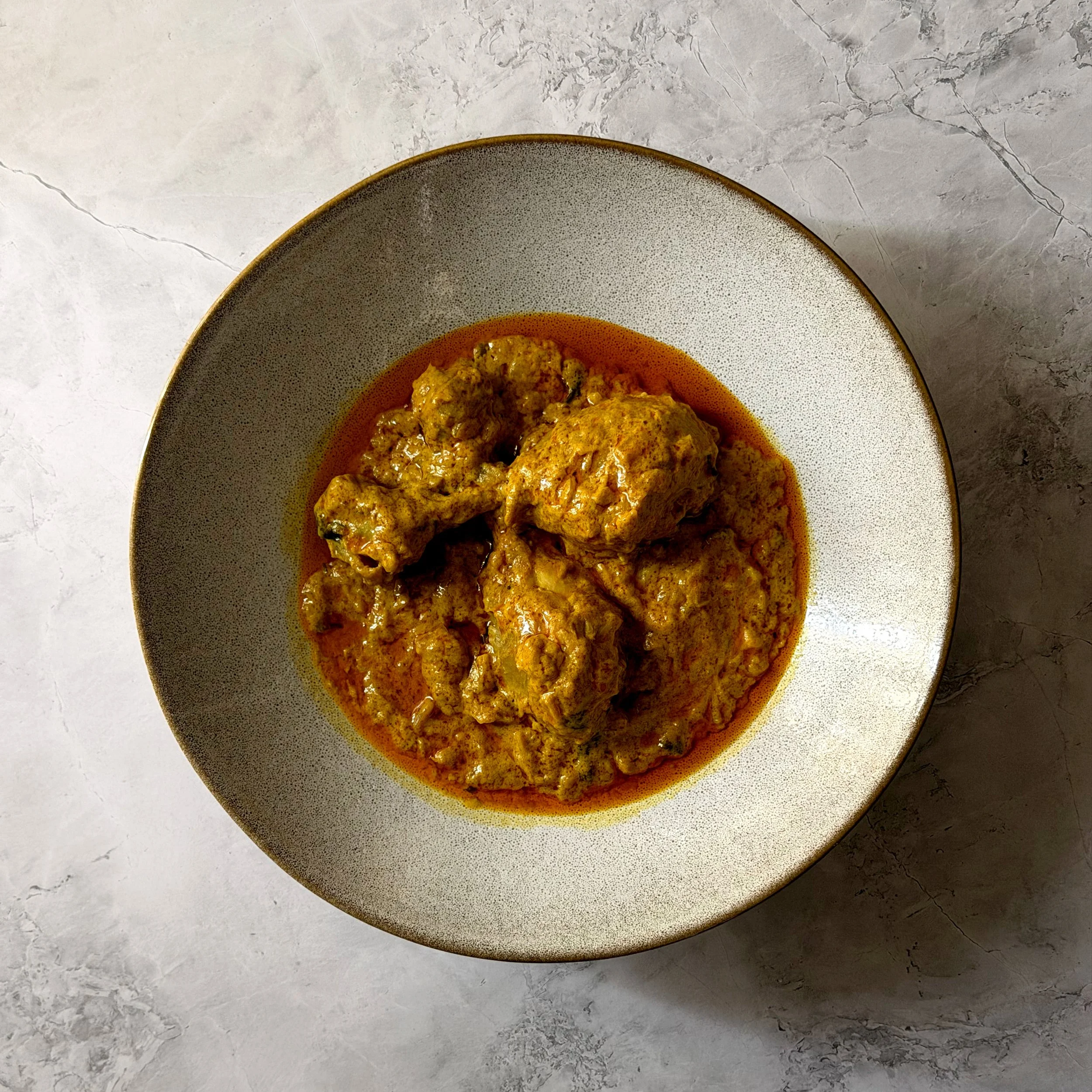
This is curry after a fairly serious journey. Its roots lead towards Goa, but the dish travelled through Portuguese-ruled Mozambique before eventually becoming part of the restaurant repertoire of Lisbon. Along the way, the sprawling spice vocabulary of Indian curry was pared down considerably. In its Portuguese form, caril is deliberately mild, creamy and fragrant, usually relying on commercial curry powder rather than a freshly ground masala.
The cooking begins with something unmistakably Portuguese: a refogado of onion, garlic, tomato and bay leaf slowly cooked in plenty of oil. Curry powder, turmeric and coconut milk then take things in another direction. The result isn't trying particularly hard to behave like an Indian curry. It's rich, yellow, pleasantly oily and comforting, with the chicken remaining very much the point of the exercise.
Apparently curry can acquire a Portuguese accent if you send it travelling for long enough.
Ingredients
120 ml vegetable oil
2 large onions, about 400 g total, finely chopped
3 bay leaves
5 garlic cloves, about 15 g, finely minced
3 tbsp tomato paste
1 tbsp curry powder
2 tsp turmeric powder
1½ cup coconut milk
1 kg bone-in chicken, preferably a mixture of thighs and drumsticks
2 tsp salt, or to taste
Small handful coriander leaves, roughly chopped
Cooked rice, to serve
A note on the curry powder
Commercial curry powder is central to this particular style rather than a shortcut for a freshly ground masala. The Lisbon restaurants on which the recipe is based use Margão curry powder, a Portuguese brand named after Margao in Goa.
If you don't have Margão, use a mild commercial curry powder rather than replacing it with garam masala or an elaborate homemade Indian masala. The relatively simple curry-powder flavour is part of the character of the dish.
The additional turmeric is intentional. The deep yellow colour is characteristic of this style of caril.
Method
Make the refogado
Heat the vegetable oil in a large, heavy-bottomed saucepan or casserole over medium heat.
Add the chopped onions and bay leaves. Cook for about 10 minutes, stirring occasionally, until the onions are completely soft and translucent. You're not looking for deeply browned onions here.
Fry the aromatics and spices
Add the garlic, tomato paste, curry powder and turmeric.
Cook over medium to medium-low heat for about 8 to 10 minutes, stirring regularly. The tomato paste should lose its rawness, the spices should become fragrant and the mixture should begin releasing oil around the edges.
Don't rush this stage. This slowly cooked onion-tomato-spice base provides much of the depth in what is otherwise a deliberately simple curry.
Cook the chicken
Pour in the coconut milk and stir thoroughly to loosen the refogado from the bottom of the pan.
Add the chicken and salt and turn the pieces through the sauce until well coated.
Increase the heat and bring everything to a gentle simmer.
Cover, lower the heat and cook for about 45 minutes, stirring and turning the chicken occasionally, until the chicken is tender.
The exact time will depend on your cuts. Drumsticks may cook slightly faster than large thighs.
Reduce the caril
Once the chicken is tender, check the consistency.
This isn't intended to be a thin, abundant curry. The finished sauce should be fairly reduced, rich and coating, with a visible sheen or small layer of oil beginning to separate on the surface.
If necessary, remove the lid and simmer for another 5 to 10 minutes, stirring occasionally, until you reach that consistency.
Taste and adjust the salt.
Rest and serve
Switch off the heat and let the curry rest for about 10 minutes.
Transfer to a serving dish and finish with chopped coriander.
Serve with plain rice. If you can get Portuguese Carolino rice, cook it simply with salt and a little butter. Otherwise, a relatively neutral white rice works perfectly well.
What this caril shouldn't be
Resist the instinct to keep adding things. It doesn't need cumin seeds, coriander powder, garam masala, ginger, green chillies or a finishing squeeze of acid simply because those things might make sense in an Indian chicken curry.
The relative restraint is the interesting part.
Onion. Garlic. Bay. Tomato. Curry powder. Turmeric. Coconut. Chicken.
For a dish whose history crosses three continents, the final ingredient list is remarkably uninterested in showing off.