
Custardy Scrambled Eggs
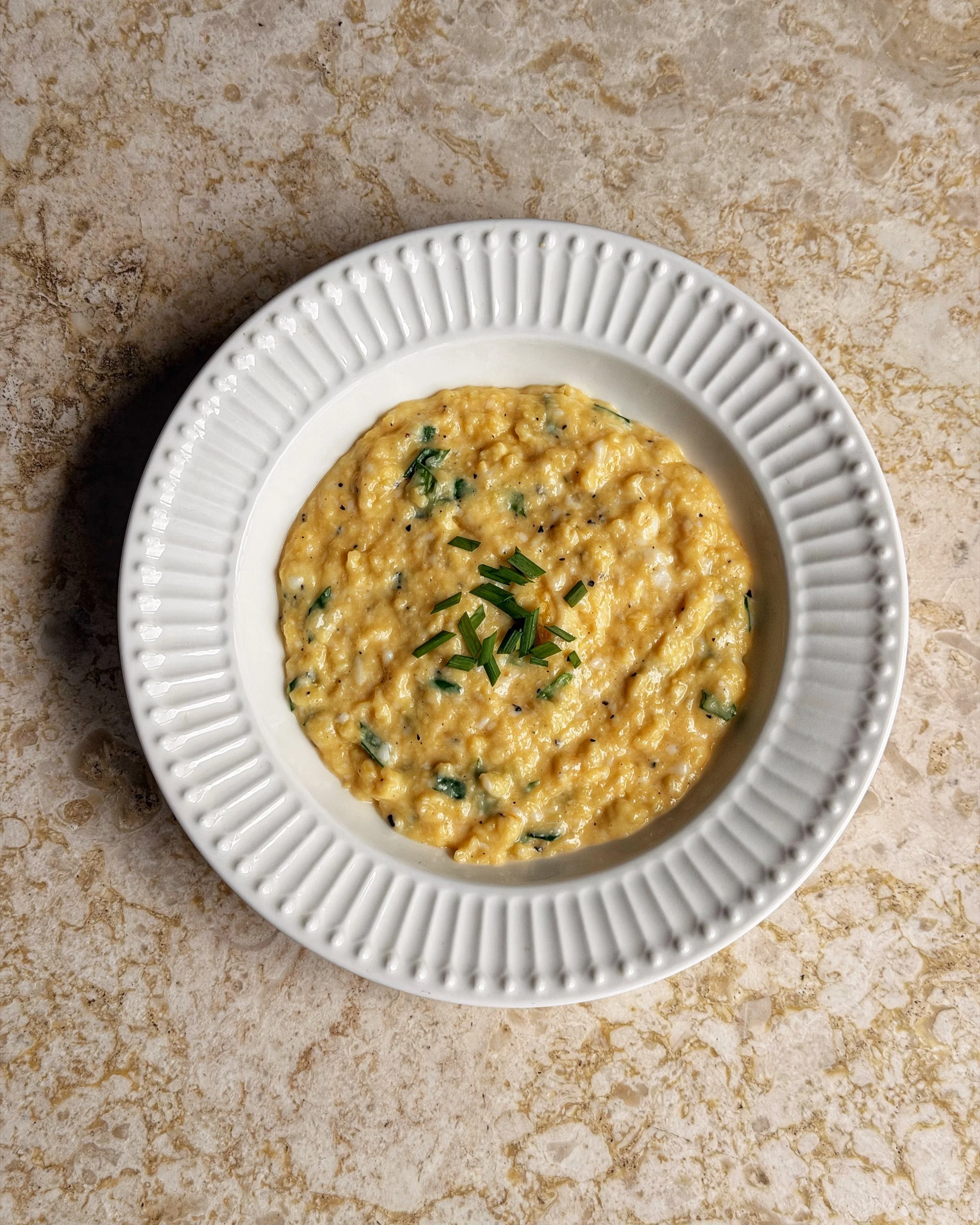
This is less a scrambled egg recipe and more a lesson in temperature control. The goal isn’t soft curds or fluffy folds, but something much closer to a loose savoury custard: glossy, creamy and just set.
The trick is to cook the eggs slowly while stirring almost constantly. Whenever they threaten to cook too quickly, you interrupt the process. Take the saucepan off the heat, add some cold butter, or do both. Think of the butter not just as an ingredient, but as a temperature-control device. It cools the pan while adding fat and richness, buying you a little more time before the proteins tighten.
It takes patience, quite a lot of stirring and an amount of butter best described as generous.
What you need
3 eggs
Butter, generously
Salt
1 generous dollop crème fraîche or a splash of heavy cream
Plenty of freshly ground black pepper
Finely chopped herbs like chives, dill, parsley etc.
The technique
Start with a saucepan, not a frying pan.
Use the smallest saucepan that will comfortably hold three eggs. Something slightly deep and narrow is ideal. A wide frying pan gives you too much hot surface area and the eggs can set before you have a chance to control them.
Start cold and stay low.
Put the saucepan over low heat and immediately add a generous knob of butter. There is no need to preheat the pan. Let the butter melt gently without browning.
Eggs straight into the saucepan.
As soon as the butter has melted, crack in all three eggs. Add a little salt and immediately begin stirring vigorously. A silicone spatula works particularly well because you can continuously scrape the bottom and corners of the saucepan.
From this point onward, keep the eggs moving.
You are deliberately trying to prevent large curds from forming. The eggs should thicken gradually and evenly, eventually becoming something closer to custard than conventional scrambled eggs.
Control the heat rather than simply cooking over it.
This is the important part.
As the eggs begin to thicken, pay attention to how quickly they are setting. If you see them starting to form flakes or curds faster than you can stir them, they are getting too hot.
You have two brakes:
Take the saucepan off the heat.
Keep stirring vigorously while the residual heat continues cooking the eggs. Return it to low heat once things have slowed down.
Add another knob of butter.
The cooler butter immediately pulls some heat from the mixture while enriching it. Stir until completely incorporated.
Use both techniques as necessary, moving the saucepan on and off the heat and adding butter perhaps two or three times during the entire process.
Don't rush it. You're trying to creep towards coagulation rather than charging straight through it.
Watch the transformation.
At first you'll have loose beaten egg. Then it will become slightly thicker and glossy. Eventually the spatula will begin leaving a trail through the eggs before the mixture slowly flows back into place.
That's the territory you're looking for.
There shouldn't really be identifiable pieces of scrambled egg. It should look like a thick, glossy egg custard.
Finish before you think they're finished.
When the eggs are almost at the consistency you want, add a generous dollop of crème fraîche or a small splash of heavy cream. Stir it through thoroughly.
This adds richness, but more importantly it gives you one final drop in temperature and helps arrest the cooking.
Take the saucepan off the heat while the eggs still look slightly looser than you want to eat them. They will continue cooking from residual heat in both the eggs and saucepan.
Taste and adjust the salt, then finish with plenty of freshly ground black pepper and finely chopped chives, dill, parsley or a mixture of soft herbs.
Serve immediately.
The principle
If you remember only one thing, remember this:
Heat makes scrambled eggs. Controlling heat makes creamy scrambled eggs.
Low heat gives you time. Constant stirring prevents large curds. Taking the pan off the flame interrupts coagulation. Adding butter drops the temperature. Crème fraîche gives you one final brake. And stopping early accounts for carryover cooking.
Once you understand that, you don't really need a recipe anymore.