
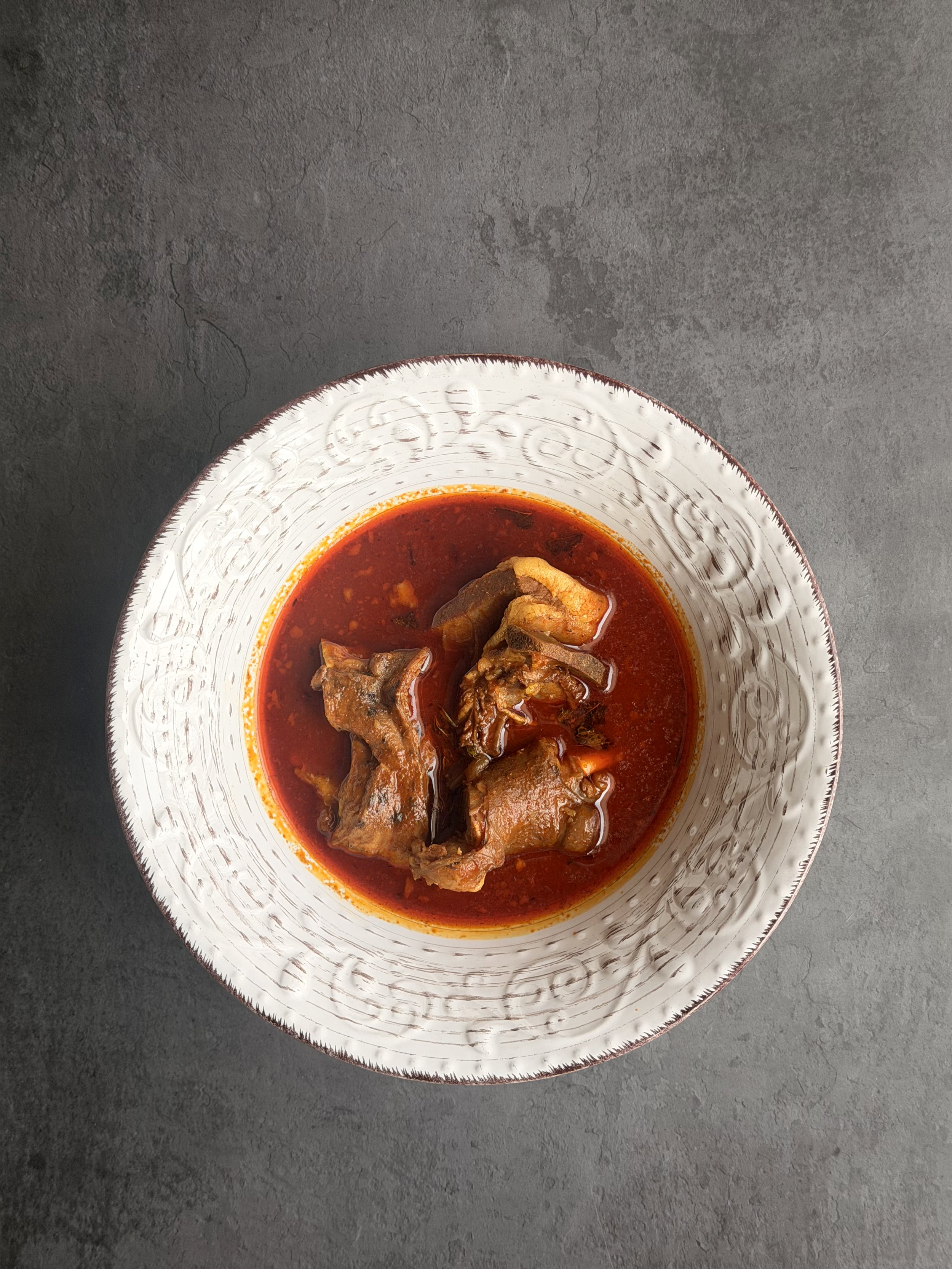
Marchwangan Korma is one of the most intensely spiced preparations associated with Kashmir's Wazwan tradition. The name refers to its defining ingredient, red chillies, which give the dish its extraordinary colour and fiery character. Unlike many North Indian meat curries, this preparation does not rely on tomatoes, yoghurt or a thick onion-based gravy. Instead, its flavour comes from Kashmiri chillies, ghee, aromatic whole spices and praan, the distinctive wild shallots used in Kashmiri cooking.
The technique involves repeatedly frying the meat with chilli paste until the fat separates, gradually building flavour and developing the characteristic deep red colour. The result is a rich, glossy curry with tender mutton, an intensely red gravy and a layer of fragrant, chilli-tinted ghee on the surface.
Ingredients
For the Mutton
Bone-in goat mutton: 1 kg, preferably a mixture of shoulder, ribs and leg pieces
Ghee: ¾ cup (approximately 170 g)
Garlic paste: 2 tsp
Salt: To taste
Hot water: As required for cooking
For the Kashmiri Chilli Paste
Whole dried Kashmiri red chillies: 15–20
Water: Enough to boil the chillies
For the Praan Paste
Praan (Kashmiri wild shallots): 1 cup, peeled and roughly chopped
Mustard oil: 2 tbsp
Reserved chilli-boiling water: As required for grinding
If praan is unavailable, regular shallots can be used as a substitute, although their flavour is somewhat different.
For the Whole Spices and Seasoning
Cinnamon: 1 stick, approximately 2 inches
Green cardamom: 6 pods
Black cardamom: 2 pods
Cloves: 5–6
Shah jeera: 1 tsp
Dry ginger powder (saunth): ½ tsp
Turmeric powder: ½ tsp
Dried mint: 1 tsp
For the Mawal Infusion (Optional)
Dried mawal flowers (cockscomb): 1 tbsp, or mawal powder
Hot water: ¼ cup (60 ml)
Method
Prepare the Kashmiri chilli paste
Remove the stems from the dried Kashmiri red chillies.
Place the chillies in a saucepan and add enough water to cover them completely.
Bring the water to a gentle simmer over low heat and cook for approximately 20 minutes, until the chillies have softened considerably.
Remove the saucepan from the heat.
Drain the chillies, reserving the cooking liquid, and allow them to cool slightly.
Transfer the softened chillies to a mixer-grinder and add a small quantity of the reserved cooking liquid.
Grind into a smooth, thick paste.
Place a fine-mesh strainer over a bowl and pass the chilli paste through it, pressing firmly with the back of a spoon to extract the smooth red pulp.
Return the remaining chilli skins and solids to the grinder, add a little more reserved cooking liquid and grind again.
Strain a second time to extract as much colour and flavour as possible.
Discard the remaining coarse skins and solids.
The finished chilli paste should be smooth, intensely red and relatively free of coarse particles.
Set aside.
Prepare the praan paste
Heat 2 tbsp mustard oil in a small frying pan over medium-low heat.
Add the chopped praan or regular shallots.
Fry gently, stirring frequently, until the shallots become soft and translucent.
Avoid browning or caramelising them. The objective is to soften the shallots and mellow their raw pungency without developing the sweet, roasted flavour associated with browned onions.
Remove the pan from the heat and allow the shallots to cool.
Transfer them to a mixer-grinder.
Add a small quantity of the reserved chilli-boiling liquid and grind into a smooth paste.
Set aside.
Blanch the mutton
Place the bone-in mutton pieces in a large saucepan or stockpot.
Add plenty of cold water, enough to cover the meat completely.
Bring the water to a vigorous boil over high heat.
Allow the mutton to boil for approximately 1 minute, during which scum and impurities will rise to the surface.
Drain the meat through a colander and discard the blanching water.
Rinse the mutton thoroughly under clean water, removing any remaining scum from the surface.
Allow the meat to drain well.
This initial blanching produces a cleaner-tasting curry and helps maintain the clarity of the finished gravy.
Fry the mutton in ghee
Place a large, heavy-bottomed handi or deep cooking pot over medium-high heat.
Add ¾ cup ghee and allow it to heat thoroughly.
Add the blanched and drained mutton pieces.
Fry the meat for approximately 5–7 minutes, stirring frequently so that the pieces are evenly coated in the hot ghee.
The surface of the mutton should begin to firm up and develop a little colour.
Add the garlic paste and salt.
Continue frying for another 1–2 minutes, until the garlic becomes fragrant and its raw aroma begins to disappear.
Take care not to burn the garlic.
Add the first portion of chilli paste
Add approximately two ladles of the prepared Kashmiri chilli paste to the mutton.
Stir thoroughly, coating every piece of meat in the red paste.
Continue frying over medium-high heat, stirring frequently.
Initially, the paste will loosen as it mixes with the ghee and moisture released by the meat.
As the water evaporates, the mixture will become thicker and the ghee will begin separating from the masala.
Continue frying until the chilli paste has reduced considerably and red-tinted ghee becomes visible around the edges of the handi.
If the masala begins sticking before the fat separates, reduce the heat slightly and add a small splash of hot water.
This repeated frying process helps develop the flavour and colour of the finished korma.
Add the praan paste
Once the ghee has separated from the first addition of chilli paste, add the prepared praan paste.
Mix thoroughly with the mutton.
Fry for approximately 2–3 minutes, stirring continuously, until the shallot paste becomes fragrant and begins integrating with the chilli masala.
Add another ladle of Kashmiri chilli paste.
Continue frying over medium to medium-high heat until the mixture thickens again and the ghee separates.
The mutton should now be coated in a concentrated, glossy red masala.
Avoid rushing this stage, as the repeated frying helps build the characteristic depth of Marchwangan Korma.
Add the remaining chilli paste and water
Pour the remaining Kashmiri chilli paste into the handi.
Stir thoroughly to coat the meat.
Add enough hot water to just cover the mutton.
Mix gently, scraping the bottom of the handi to release any concentrated masala that may have adhered during frying.
Increase the heat and bring the liquid to a boil.
The gravy should now have a vivid red colour.
Add the spices and simmer
Once the gravy comes to a boil, add the turmeric powder and dry ginger powder.
Add the cinnamon stick, green cardamom, black cardamom and cloves.
Stir gently to distribute the spices.
Reduce the heat to low and cover the handi with a lid.
Allow the mutton to simmer gently until tender.
Depending on the age and cut of the goat, this may take approximately 60–120 minutes.
Check the curry occasionally and stir gently to prevent the meat or chilli paste from sticking to the bottom.
If the gravy reduces too quickly before the meat is cooked, add small quantities of hot water.
Avoid adding excessive water, as the finished korma should have a medium thick, concentrated gravy rather than a thin broth.
The mutton is ready when the meat becomes tender and separates easily from the bone without completely falling apart.
Prepare the mawal infusion
If using mawal, place it in a small bowl and pour over approximately ¼ cup hot water.
Allow to steep for 10–15 minutes.
The water will gradually develop a reddish colour.
Strain the infusion.
Set aside until the mutton is tender.
Mawal is traditionally used in certain Kashmiri meat preparations to enhance the colour of the gravy.
Add the mawal, shah jeera and dried mint
Once the mutton is fully tender, remove the lid.
Pour in the prepared mawal infusion, if using.
Add the shah jeera and dried mint.
Stir gently to combine.
Allow the korma to simmer uncovered over low heat for another 5–8 minutes.
During this final simmer, the gravy should become slightly more concentrated and the spices should integrate into the sauce.
Taste and adjust the salt.
The finished gravy should be intensely red, glossy and moderately thick, with some red-tinted ghee visible on the surface.
Rest and serve
Turn off the heat and cover the handi.
Allow the Marchwangan Korma to rest for approximately 15–20 minutes before serving.
This resting period allows the flavours to settle and the ghee to rise naturally to the surface.
Transfer the mutton to a serving bowl, spooning the rich red gravy and some of the fragrant ghee over the meat.
Serve hot with steamed rice.