
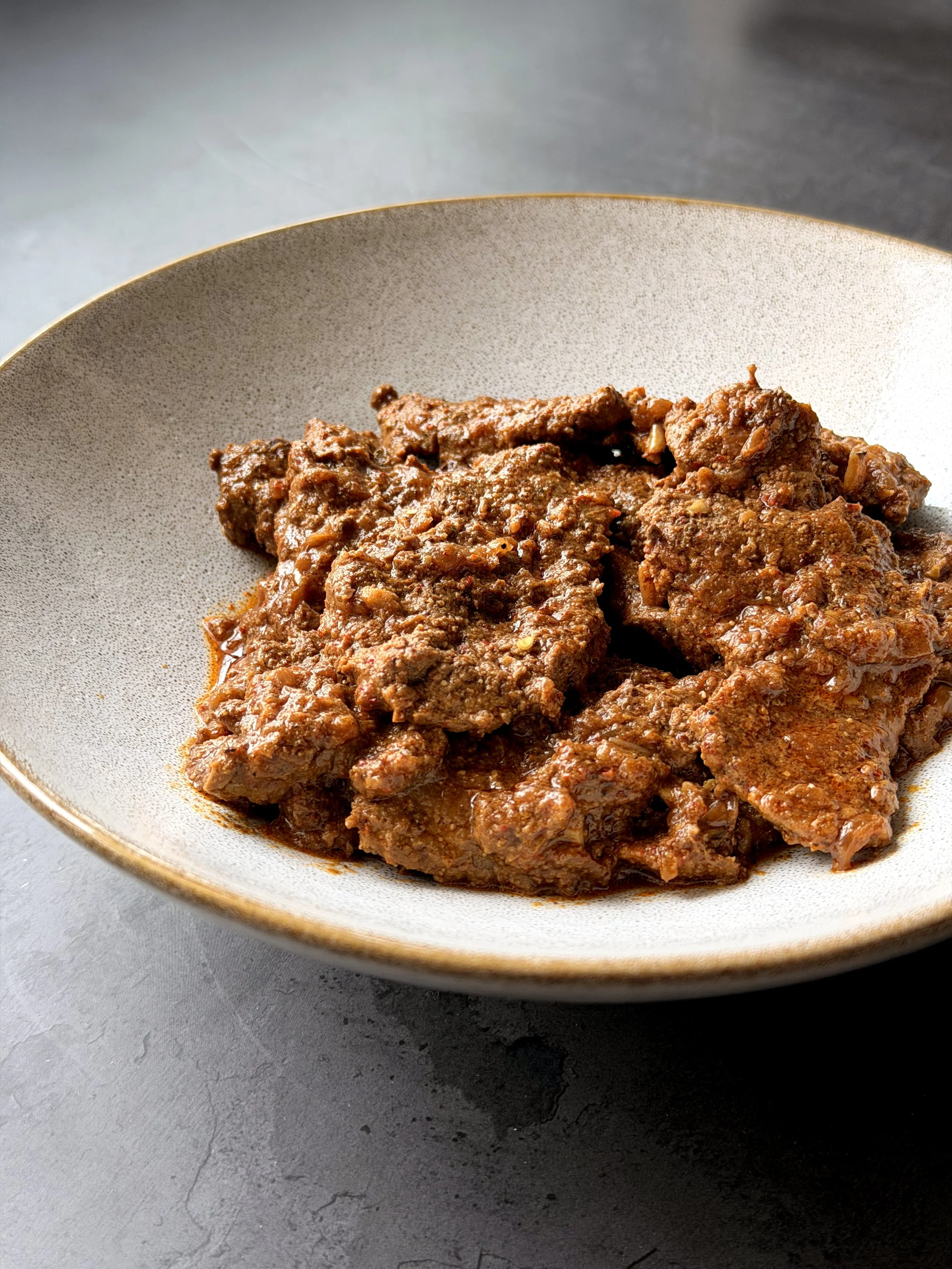
Thin slices of beef, tenderised and marinated overnight in yogurt, browned onions and a fragrant blend of roasted spices, then gently cooked until tender in a thick, richly flavoured gravy.
Unlike many meat curries, pasanday are prepared using thin, flattened slices of meat rather than cubes or bone-in pieces. The meat is briefly seared before being simmered in its marinade, allowing the spices, yogurt and fried onions to develop into a concentrated gravy that coats each slice.
Ingredients
For the pasanda masala
1 tsp black peppercorns
2 tsp coriander seeds
2 tsp cumin seeds
2 tsp black mustard seeds
1 tsp cloves
1 tsp green cardamom seeds, removed from their pods
2-inch piece cinnamon
20 almonds
10 dried red chillies
2 tbsp white poppy seeds (khus khus)
2 tsp salt, or to taste
½ tsp turmeric powder
2 tsp red chilli powder
For the marinade
1 cup (approximately 240 g) plain curd, preferably thick
2 tsp lemon juice
2 tsp vinegar
1 tbsp ginger paste
1 tbsp garlic paste
All the prepared pasanda masala
2 large onions, thinly sliced
½ cup (120 ml) neutral oil, for frying the onions
For the pasanday
1 kg beef undercut or tenderloin, cut into thin slices
All the prepared marinade
½ cup (approximately 110–115 g) ghee
Approximately 2 cups (480 ml) water, adjusted as necessary
Method
Prepare the pasanda masala
Place a heavy-bottomed frying pan over low to medium-low heat.
Add the black peppercorns, coriander seeds, cumin seeds, black mustard seeds, cloves, cardamom seeds, cinnamon, almonds, dried red chillies and poppy seeds.
Dry-roast the ingredients for approximately 2–3 minutes, stirring frequently, until the spices become fragrant and the almonds begin to develop a lightly toasted aroma.
Avoid roasting them too aggressively. The spices should become aromatic without turning dark or acquiring a burnt flavour.
Remove from the heat and allow the mixture to cool completely.
Transfer to a spice grinder and grind to a fine powder. The almonds and poppy seeds should be ground as finely as possible, as they will eventually help thicken the gravy.
Add the turmeric powder, red chilli powder and salt.
Mix thoroughly and set aside.
Fry the onions
Heat ½ cup oil in a kadai or heavy-bottomed frying pan over medium heat.
Add the thinly sliced onions and fry, stirring frequently, until they turn an even golden brown.
As the onions approach the desired colour, reduce the heat slightly and stir more frequently. They can go from golden to burnt very quickly.
Remove the onions using a slotted spoon and spread them on a plate lined with kitchen paper.
Allow them to cool completely. They will become slightly crisp as they cool.
Once cooled, lightly crush the fried onions with your fingers.
Reserve the onions for the marinade.
Prepare the marinade
In a large, non-reactive mixing bowl, whisk the curd until smooth.
Add the lemon juice, vinegar, ginger paste and garlic paste.
Stir in the prepared pasanda masala, followed by the crushed fried onions.
Mix thoroughly until the ingredients form a thick, evenly combined marinade.
The fried onions will soften as they absorb moisture from the yogurt, eventually contributing sweetness and body to the gravy.
Prepare the beef
Cut the beef against the grain into thin, broad slices, approximately 5 × 10 cm and 5-6 mm thick.
If the meat is difficult to slice thinly, place it in the freezer for 20–30 minutes to firm it up slightly before cutting.
Arrange the slices between two sheets of baking paper or plastic wrap.
Using a meat mallet, gently pound each slice to an even thickness.
The objective is to flatten and tenderise the meat without tearing it apart.
Traditional pasanday are characterised by these thin, flattened pieces of meat, which allow the marinade to penetrate the surface and help the meat cook relatively quickly.
Marinate overnight
Add the prepared beef slices to the marinade.
Using your hands or a spatula, coat each piece thoroughly, making sure the marinade reaches between the slices.
Cover the bowl and refrigerate overnight, preferably for 8–12 hours.
The yogurt, lemon juice and vinegar provide acidity, while the ginger, garlic and spices flavour the surface of the beef.
Sear the beef
Remove the marinated beef from the refrigerator shortly before cooking.
Lift the beef slices out of the marinade one at a time, allowing the excess marinade to fall back into the bowl.
Reserve all the remaining marinade. It will form the base of the gravy.
Heat the ghee in a wide, heavy-bottomed kadai over medium-high heat.
Working in batches, arrange the beef slices in a single layer and sear briefly on both sides until lightly browned.
Avoid overcrowding the pan, as this will cause the meat to release moisture and steam rather than sear.
Transfer the seared beef to a plate and keep covered while you prepare the gravy.
The beef does not need to be fully cooked at this stage.
Cook the marinade
Reduce the heat to medium-low.
Add the reserved marinade to the same kadai, scraping up any browned bits left behind by the beef.
Stir continuously for the first few minutes to prevent the yogurt from catching on the bottom of the pan.
Cook until the marinade begins to thicken and the raw aroma of the spices disappears.
Gradually add approximately 2 cups of water, stirring to incorporate it into the masala.
Bring the mixture to a gentle simmer.
Simmer the pasanday
Return the seared beef slices to the kadai, along with any juices collected on the plate.
Gently turn the slices to coat them evenly with the gravy.
Reduce the heat to low, cover and simmer until the beef is completely tender.
The cooking time will depend on the cut and thickness of the meat. Thin slices of tenderloin may require considerably less cooking than slices from a firmer cut.
Check periodically and stir gently to prevent the gravy from sticking.
If the liquid reduces too quickly before the beef becomes tender, add a little hot water.
Avoid vigorous stirring, as the thin slices can break apart once tender.
Reduce the gravy
Once the beef is tender, remove the lid and increase the heat to medium.
Allow the gravy to reduce, stirring and turning the meat occasionally.
As the excess moisture evaporates, the yogurt, ground almonds, poppy seeds and fried onions will combine to form a thick, rich masala.
Continue cooking until the gravy clings to the beef rather than pooling around it.
The finished pasanday should be coated in a concentrated, aromatic gravy, with a little ghee beginning to separate around the edges.
Taste and adjust the salt if necessary.
Rest and serve
Turn off the heat and cover the kadai.
Allow the pasanday to rest for approximately 10–15 minutes before serving.
This gives the gravy time to settle and allows the meat to absorb some of the surrounding flavours.
Serve hot with naan, roomali roti, paratha or plain basmati rice.
Notes
Choosing the beef: Undercut or tenderloin is particularly suitable because it can be sliced thinly and cooks quickly. Other reasonably tender boneless cuts can also be used, although they may require longer simmering. Avoid prolonged cooking of very lean tenderloin once it is tender, as it can become dry.
Cutting against the grain: Slicing perpendicular to the direction of the muscle fibres shortens them, making the beef easier to chew. Gentle pounding further improves tenderness and ensures an even thickness.
The final consistency: Pasanday are generally served with a thick, concentrated gravy that coats the meat. This is not intended to be a thin, soupy curry. The final reduction is therefore an important part of the recipe.
Ghee: The original preparation uses a generous ½ cup of ghee for searing and cooking the meat. For a somewhat lighter version, the quantity can be reduced, although this will change the richness of the finished dish.
Make ahead: Like many slow-cooked meat dishes, pasanday can develop a more rounded flavour after resting overnight in the refrigerator. Reheat gently with a splash of water to loosen the gravy, taking care not to overcook the beef.