
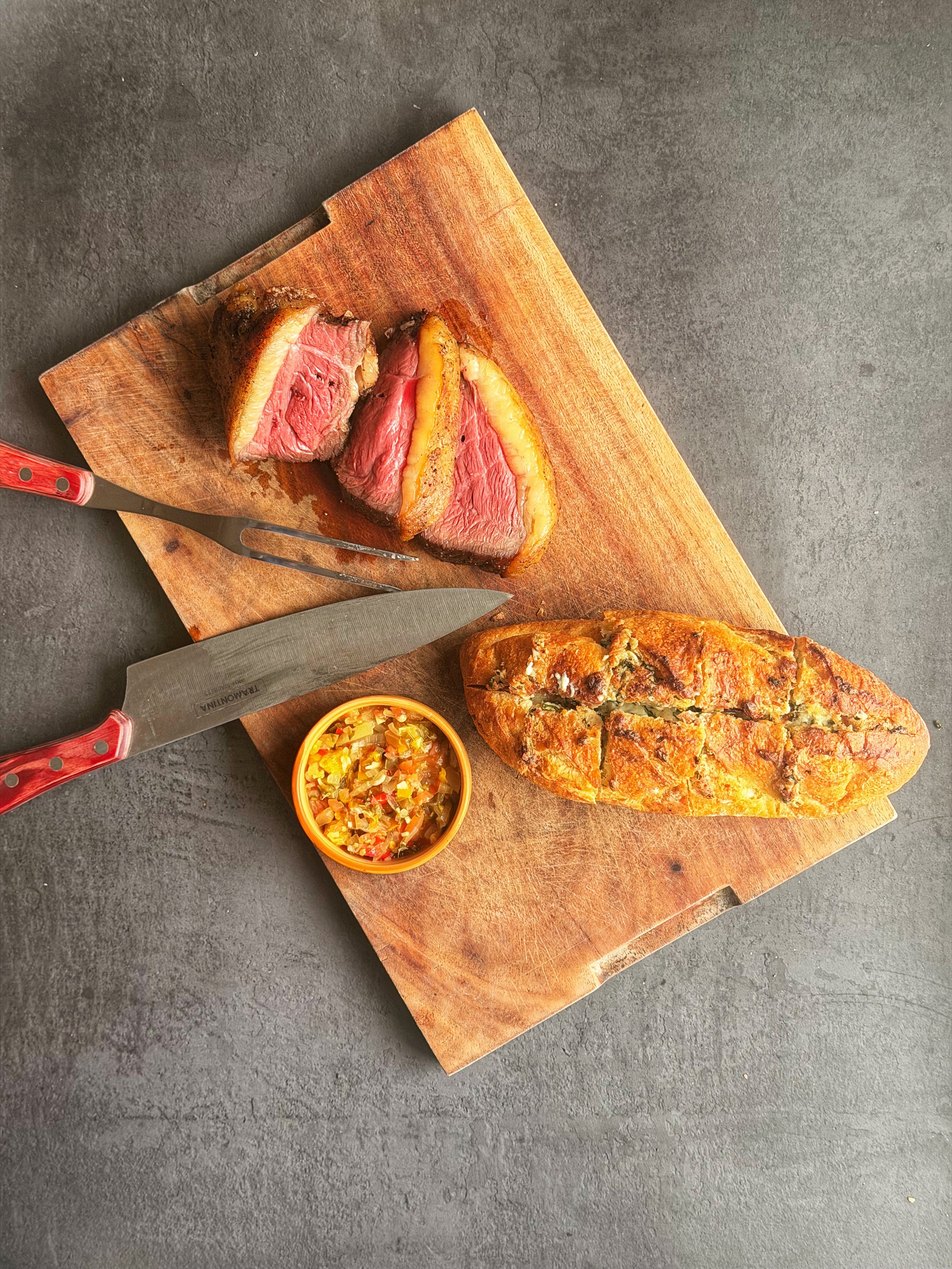
A Brazilian churrasco-inspired preparation adapted for an indoor kitchen. The picanha is slowly roasted at a low temperature, then finished in cast iron to develop a golden, crisp fat cap and a deeply browned crust. It's served with pão de alho, Brazilian-style garlic bread stuffed with a creamy mixture of butter, garlic, mayonnaise and cheese.
Ingredients
For the picanha
500 g whole picanha, fat cap intact
5–6 g coarse sea salt, preferably sal grosso or coarse kosher salt
1 tsp neutral oil, only if necessary
Freshly ground black pepper, optional, to finish
For the pão de alho
2 small baguettes
40 g butter, softened
3 tbsp mayonnaise
4–5 garlic cloves, finely grated
40 g mozzarella, finely grated
20 g Parmesan, finely grated, optional
1 tbsp parsley, finely chopped
¼ tsp freshly ground black pepper
Salt, to taste
Method
Prepare and season the picanha
Remove the picanha from its packaging and pat it thoroughly dry with kitchen paper.
Examine the fat cap. Ideally, it should be approximately 5–8 mm thick. If considerably thicker, trim away some of the excess without removing the cap entirely.
Leave the fat unscored. An uninterrupted layer renders beautifully and gives the finished slices their characteristic appearance.
Season the beef evenly on all sides with the coarse salt.
For best results, place it uncovered on a wire rack in the refrigerator for 4–12 hours. This allows the salt to penetrate the meat while drying the surface for better browning.
If cooking immediately, season just before roasting.
Slowly roast the beef
Preheat the oven to 110°C, conventional heat.
Place the picanha fat-side-up on a wire rack set over a shallow roasting tray.
Insert a temperature probe horizontally into the thickest part of the meat, avoiding the fat cap.
Roast until the centre reaches the appropriate temperature:
Desired doneness
Remove from oven at
Rare 40–42°C
Medium-rare 44–46°C
Medium 49–51°C
These temperatures allow for additional cooking during the final sear and resting period.
Render the fat cap
Remove the picanha from the oven.
Heat a heavy cast-iron skillet over medium-low heat.
Place the beef fat-side-down in the dry skillet. Additional oil is generally unnecessary, as the fat will begin rendering almost immediately.
If the shape prevents the fat cap from making even contact, hold the meat gently with tongs.
Cook for approximately 4–7 minutes, adjusting the heat as necessary.
The fat should become noticeably thinner, deep golden and crisp on the outside.
If excessive fat accumulates in the skillet, carefully spoon some away. Reserve it for roasting potatoes or vegetables.
Sear the meat
Increase the heat to medium-high.
Sear the exposed meat side for approximately 45–60 seconds, then briefly brown the edges.
Since the beef is already partially cooked, the objective is to develop a crust without overcooking the centre.
Check the internal temperature. For medium-rare, aim for a final temperature of approximately 54–57°C after resting, removing the meat from the skillet a few degrees earlier to account for carryover cooking.
Rest and carve
Transfer the picanha to a board and rest uncovered for 7–10 minutes.
Avoid wrapping it tightly in foil, as trapped steam can soften the crisp fat cap.
Identify the direction of the muscle fibres. Using a sharp carving knife, slice the beef across the grain into approximately 8–12 mm thick slices.
Arrange the slices with the browned fat cap visible. Finish with freshly ground black pepper, if using.
Prepare the pão de alho
While the beef is roasting, prepare the garlic bread.
Combine the softened butter, mayonnaise, grated garlic, mozzarella, Parmesan, parsley and black pepper in a bowl.
Mix thoroughly until you have a thick, spreadable paste.
Taste before adding salt, as the mayonnaise and cheeses already contribute seasoning.
Cut and stuff the bread
Make deep crosswise cuts along each baguette, approximately 2 cm apart.
Stop just before reaching the bottom crust so the bread remains connected, creating an accordion-like loaf.
Spread the garlic mixture generously between the cuts, ensuring it reaches well into the bread.
Spread any remaining mixture over the top.
Bake the pão de alho
Once the picanha has finished roasting, increase the oven temperature to 200°C.
Arrange the stuffed baguettes on a baking tray and bake for 10–15 minutes, until the filling is bubbling, the cheese has melted and the exposed edges are crisp.
For additional browning, finish under the grill for 1–2 minutes, watching carefully to prevent the garlic from burning.
Serve
Arrange the sliced picanha on a wooden board or serving platter, with the crisp fat cap facing upwards.
Serve immediately with the hot pão de alho.
The beef should have a deeply browned exterior, a rosy centre and a distinct strip of rendered fat. The garlic bread should be crisp outside, soft inside and generously filled with melted garlic-cheese butter.