
Pork Jjajangmyeon
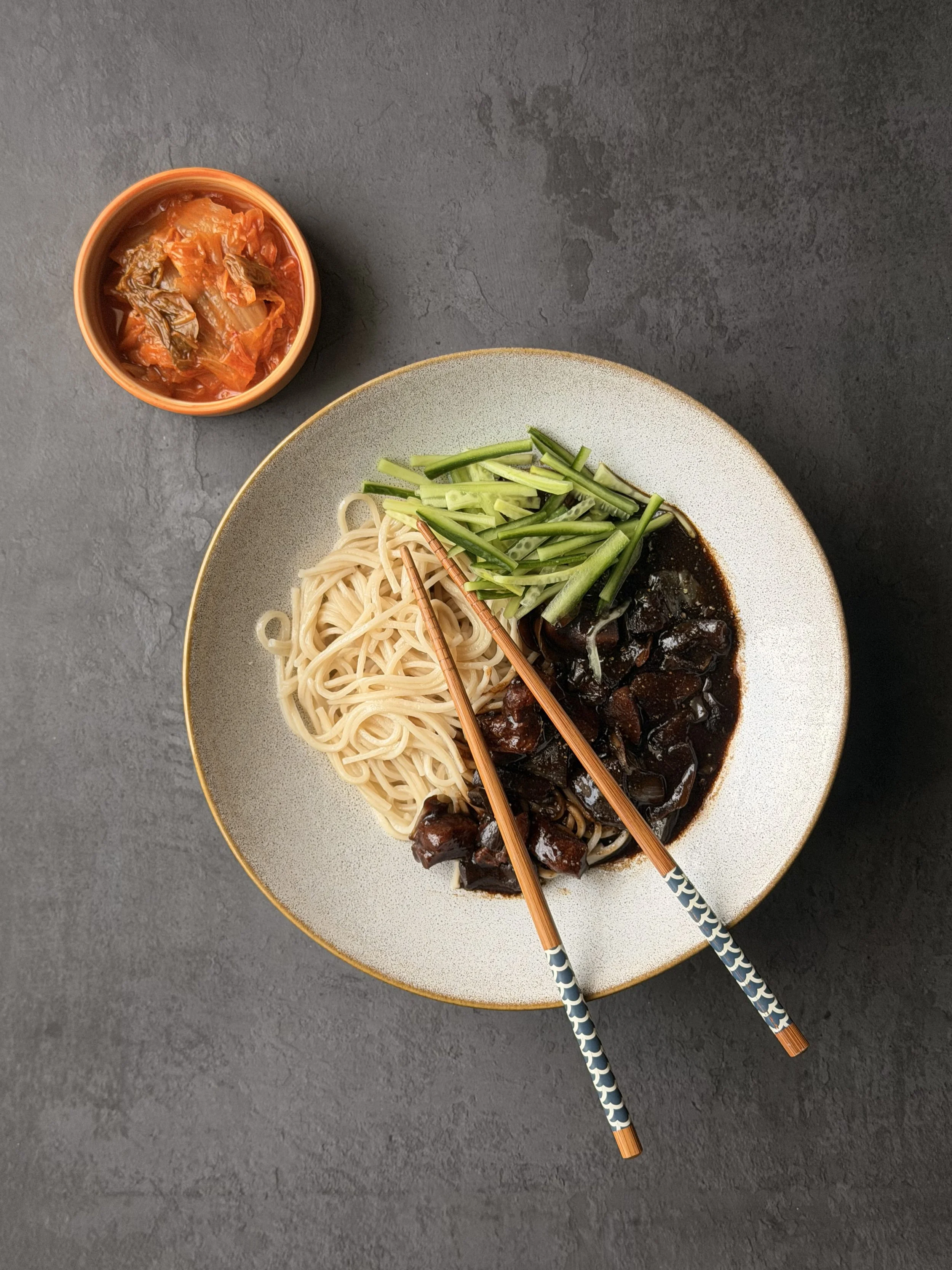
Jjajangmyeon is one of Korea’s most recognisable Korean-Chinese dishes, descended from Chinese zhajiangmian and adapted by Chinese migrants in Korea to local tastes. Thick wheat noodles are covered in a glossy, savoury-sweet sauce built around chunjang, the intensely dark Korean fermented black bean paste.
Ingredients
Pork
250 g pork belly, cut into 1–1.5 cm cubes
1 tbsp neutral oil, only if required
1 tbsp Shaoxing wine or cooking sake, optional
Freshly ground black pepper
Vegetables
1½ cups onion, cut into chunks
1 cup cabbage, roughly diced
1 cup zucchini, cut into cubes
1 cup potato, peeled and cut into 1–1.5 cm cubes
2–3 cloves garlic, finely chopped, optional
½ cup cucumber, julienned, for garnish
Jjajang Sauce
¼ cup + 1 tbsp chunjang (Korean fermented black bean paste)
1–1½ tsp sugar
1 tsp light soy sauce
2 cups hot water
2 tbsp potato starch or cornflour
4 tbsp cold water
1 tsp perilla seed oil or toasted sesame oil
To Serve
Wheat noodles, enough for 3–4 portions
Kimchi
Method
Render the pork
Place the pork belly in a large wok or kadai over medium-high heat. There should be enough fat in the belly that you won't need additional oil, but add a little neutral oil if your pork is particularly lean.
Cook until the pork has rendered a good amount of fat and is deeply browned around the edges. It doesn't need to be completely cooked through at this stage.
Fry the chunjang
Push the pork to one side of the wok or remove it temporarily. You want roughly 3 tbsp of rendered fat remaining in the wok, so spoon out any excess.
Reduce the heat to medium-low and add the chunjang directly to the fat. Fry for 2–3 minutes, stirring continuously, until the paste becomes smoother, shinier and aromatic.
Don't skip this step. Frying mellows the bitter, aggressively fermented edge of the chunjang and gives the finished sauce its characteristic rounded flavour.
Add the sugar and fry for another 20–30 seconds.
Build the sauce
Return the pork to the wok if you removed it.
Add the vegetables in roughly this order: onion, potato, cabbage and zucchini. Increase the heat and stir-fry for 4–5 minutes, allowing the vegetables to pick up the chunjang and pork fat.
Add the garlic, if using, and fry briefly.
Add the light soy sauce and Shaoxing wine, followed by 2 cups hot water. Stir well, scraping up anything stuck to the bottom of the wok.
Bring to a simmer, then reduce the heat and cover. Cook for 15–20 minutes, or until the pork is tender and the potatoes are completely cooked. Add a splash of hot water if the sauce reduces too quickly.
Thicken the jjajang
Mix the potato starch or cornflour with 4 tbsp cold water until completely smooth.
Bring the sauce back to a steady simmer. Pour in the slurry gradually while stirring. You may not need all of it.
Stop when the sauce is thick, dark and glossy, with enough body to cling generously to the noodles rather than running to the bottom of the bowl.
Simmer for another 1–2 minutes to cook out the raw starch flavour.
Finish with the perilla seed oil and plenty of freshly ground black pepper.
Taste before adding any salt. Chunjang and soy sauce already bring considerable salinity.
Cook the noodles
Cook the wheat noodles according to the packet instructions. Drain well and immediately divide between serving bowls.
Spoon a generous amount of hot pork jjajang over each portion and finish with a small pile of julienned cucumber.
Serve with kimchi alongside.
And then comes the important part: mix everything aggressively until every noodle is completely coated in that black, glossy sauce.