
Laal Maas
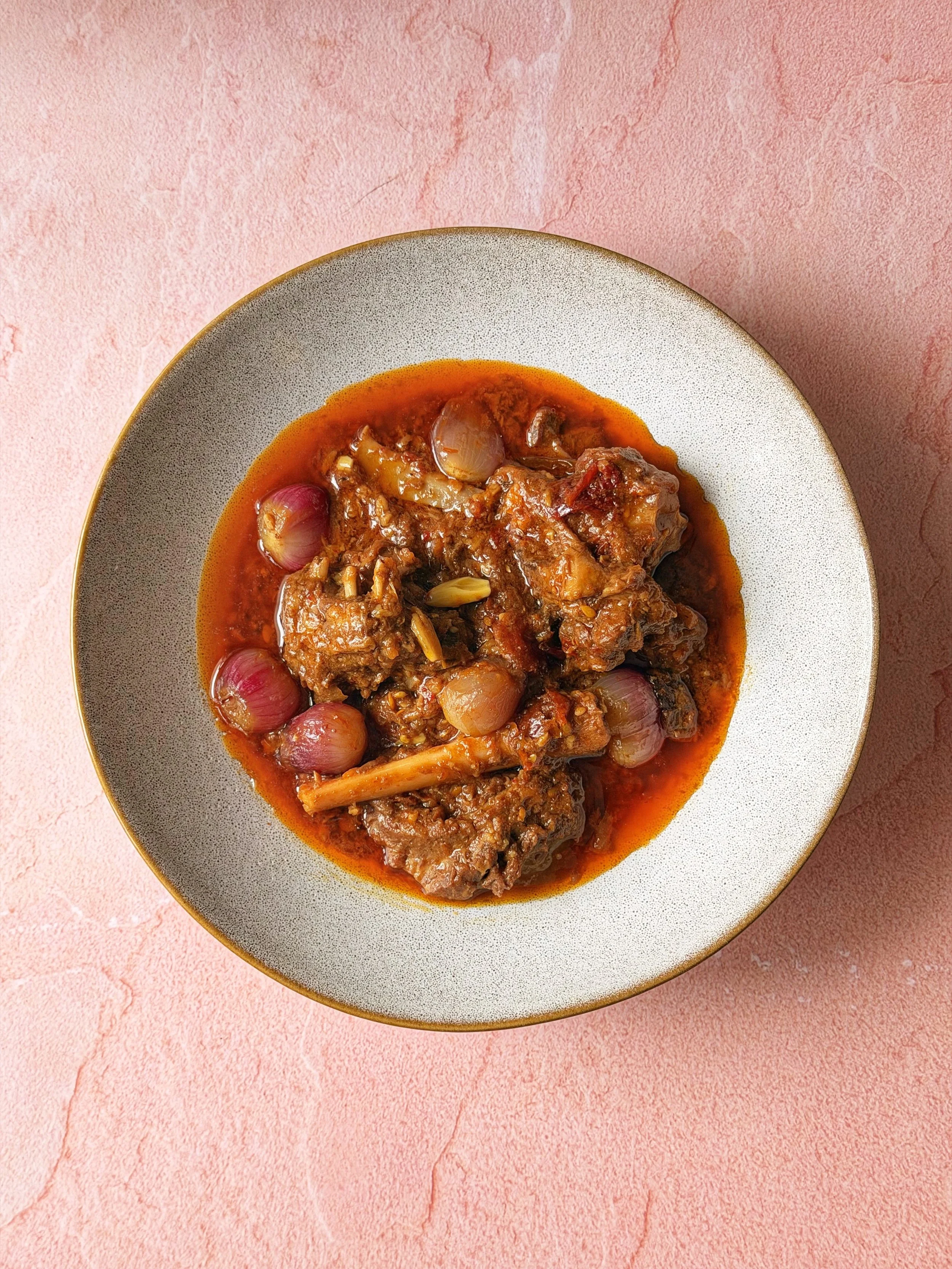
This version of Laal Maas pulls together ideas from several Rajasthani recipes rather than trying to establish one definitive version. It uses bone-in goat, Mathania chillies in two different ways, mustard oil, sour curd, kachri and a fairly unreasonable quantity of garlic. The meat gets an early dhungar before cooking, inspired by a Mewar preparation, while the two treatments of onion take a cue from Digvijaya Singh Sailana's Do Peeaza Lal Mirch. The result is intensely chilli-forward, sour, garlicky and smoky, with whole shallots remaining intact among the meat.
Ingredients
For the meat
1.5 kg bone-in goat, preferably a mix of shoulder, neck, ribs and leg, cut into medium-large pieces
The exact proportions aren't critical. What matters is using several bone-in cuts rather than only lean leg meat. The shoulder and neck bring collagen, the ribs contribute fat and bone flavour, and the leg gives you larger, meatier pieces.
For the marinade
300 g thick sour curd
25 g whole dried kachri
1½ tsp turmeric powder
2½ tsp salt
For the dhungar
1 small piece natural lump charcoal
1 tsp ghee
For the Mathania chillies
45 dried Mathania chillies
30 chillies, for the paste
15 chillies, torn into 2–3 pieces
Hot water, as required
Whole spices
4 black cardamom pods, lightly cracked
7 cloves
2 tsp cumin seeds
2 pieces cinnamon, about 4 cm each
3 bay leaves
For the curry
150 ml mustard oil
200 g onions, thinly sliced
70 g peeled garlic, about 3 whole pods, coarsely pounded
2 tbsp coriander seeds, roughly pounded
200 g small shallots, peeled and kept whole
450–650 ml hot water, as required
Salt, as required
Method
Prepare the kachri
Break the 25 g dried kachri into smaller pieces. If they're particularly hard, give them a careful whack with a rolling pin or the back of a heavy knife first.
Cover with hot water and soak for 45–60 minutes, until sufficiently softened to grind.
Drain, reserving a little of the soaking water, and grind the kachri to a smooth paste using only as much liquid as necessary.
Make the Mathania chilli paste
Remove the stems from all 45 Mathania chillies.
Take 30 chillies, shake out most of the seeds and soak them in hot water for 30–45 minutes.
Drain, reserving a little soaking water, then grind into a smooth, deep-red paste. Use as little water as possible. You want a concentrated chilli paste rather than a watery puree.
Take the remaining 15 chillies, tear each into 2–3 pieces and shake out some of the loose seeds. Keep these aside for tempering.
Using the chilli in two forms gives the dish two slightly different expressions of Mathania. The paste provides the colour and body of the masala, while the torn chillies fry directly in the mustard oil with the whole spices.
Marinate the goat
Whisk together:
sour curd
kachri paste
turmeric
salt
Add the goat and massage the marinade thoroughly into every piece.
Cover and refrigerate for 2-4 hours.
Kachri isn't just contributing sourness and its characteristic earthy flavour here. It also tenderises meat, so there is little advantage in leaving the goat in this marinade overnight.
Remove from the refrigerator about 30 minutes before cooking.
Give the marinated meat a dhungar
This dhungar happens before cooking rather than at the end.
Transfer the marinated goat to a wide vessel if it isn't already in one. Make a small space in the centre and place a heatproof steel katori among the meat.
Heat a small piece of natural lump charcoal directly over a flame until it is completely red-hot.
Using tongs, place the glowing charcoal inside the katori. Throw a few whole spices if you are feeling particularly indulgent. Pour 1 tsp ghee directly over it and immediately cover the vessel tightly.
Leave covered for 3–4 minutes.
Remove the lid, discard the charcoal and katori, and gently turn the meat through the marinade.
The idea isn't to make the goat taste overtly smoked. Because the meat subsequently goes through a long bhunao and braise, this early smoke settles into the background and gives the finished curry a subtler wood-fire character.
Pound the garlic
Coarsely pound the 70 g peeled garlic.
Don't turn it into a completely smooth paste. A little texture is desirable.
Set aside approximately one-quarter of the garlic. The larger portion goes into the initial masala, while the reserved garlic is added towards the end of cooking.
Brown the onions
Use a large, heavy-bottomed handi or Dutch oven, ideally around 5–6 litres.
Heat the 150 ml mustard oil until it just begins to smoke. Turn off the heat and let it settle for about a minute, then return it to medium heat.
Add the 200 g sliced onions.
Fry, stirring frequently, for about 10–15 minutes, until evenly golden brown.
Take them beyond merely softened onion, but don't fry them as dark as birista.
Bloom the whole spices and torn chillies
To the golden onions and mustard oil, add:
black cardamom
cloves
cumin seeds
cinnamon
bay leaves
15 torn Mathania chillies
Fry for 30–45 seconds, stirring continuously.
The spices should become aromatic and the chillies should fry in the mustard oil without blackening.
Add the garlic
Add three-quarters of the pounded garlic.
Cook over medium-low heat for 2–3 minutes, until the harsh raw aroma disappears and the garlic just begins to colour.
Do not brown it heavily.
Bhuno the goat
Lift the goat pieces from their marinade, allowing excess marinade to drip back into the bowl.
Keep all the remaining marinade.
Increase the heat to medium-high and add the goat. If your cooking vessel isn't particularly wide, work in two batches initially so the meat fries rather than immediately steaming.
Once all the goat is in the pot, bhuno for 12–15 minutes, turning regularly.
The meat will release moisture at first. Keep cooking until much of that liquid evaporates and the goat begins frying again in the mustard oil, onion and garlic.
A little colour developing around the edges of the meat is desirable.
Add the coriander and Mathania paste
Add the 2 tbsp roughly pounded coriander seeds and fry for about a minute.
Reduce the heat to medium and add all of the Mathania paste.
Bhuno for 6–8 minutes, turning the meat frequently and scraping the bottom of the pot.
The raw chilli aroma should disappear, the colour should deepen and the mustard oil should begin taking on an intense red colour.
Don't rush this stage. With this much chilli paste, properly frying it is particularly important.
Add the curd and kachri marinade
Reduce the heat to low.
Whisk the reserved curd-kachri marinade until smooth.
Add it to the pot in 3–4 additions, stirring thoroughly after each addition.
Once all the marinade has been incorporated, increase the heat to medium-low and bhuno for another 10–12 minutes.
The curd should cook down into the masala and the red-stained mustard oil should gradually begin separating around the edges.
Add the shallots
Add the 200 g whole peeled shallots.
Gently turn them through the masala and fry for about 3 minutes.
Unlike the sliced onions, the shallots aren't meant to disappear into the gravy. They should remain recognisable as a separate element in the finished Laal Maas.
Slow-cook
Add 450 ml hot water and bring everything to a boil, scraping any concentrated masala from the bottom of the pot.
Reduce to a gentle simmer and cover.
Cook for approximately 60–90 minutes, checking every 15–20 minutes.
Turn the meat occasionally rather than stirring vigorously so the shallots remain intact.
If the curry becomes too dry before the goat is tender, add additional hot water in 50–100 ml increments.
Start checking the shallots after about 30 minutes. Once they're tender but still holding their shape, remove them with a slotted spoon and keep aside while the goat continues cooking.
The goat determines the cooking time, not the shallots.
Add the remaining garlic
When the goat is almost tender, add the reserved quarter of the pounded garlic.
Cook for another 15–20 minutes, or until the goat is completely tender and the later addition of garlic has lost its rawness.
Adding garlic twice gives the finished curry a more pronounced garlic character without leaving it tasting raw.
Reduce the gravy
Once the goat is tender, remove the lid and increase the heat to medium.
Reduce for 10–20 minutes, stirring carefully, until the gravy becomes concentrated and begins clinging to the meat.
Return the shallots during the final 5 minutes.
The finished Laal Maas shouldn't be swimming in gravy. You're looking for a relatively thick, intensely red masala around the meat, a modest amount of sauce underneath, and red-stained mustard oil clearly separating around the edges.
Taste and adjust the salt.
Rest
Turn off the heat, cover and allow the Laal Maas to rest for at least 30 minutes before serving.
It is even better cooked a few hours ahead and gently reheated before eating. The chilli, garlic, kachri, curd and smoke become considerably more integrated after resting.
To Serve
Serve with bajra roti, thick wheat rotis or plain steamed rice.
The finished dish should have large bone-in pieces of goat coated in a deep-red masala, occasional torn Mathania chillies, soft whole shallots and red mustard oil separating around the edges. The smoke shouldn't immediately announce itself as dhungar. It should sit quietly underneath everything else, suggesting the wood fire this style of cooking would traditionally have encountered.